Theoretical Foundations
Mathematical Framework for Computational Coopetition
This section provides comprehensive documentation of the theoretical foundations underlying Coopetition-Gym, derived from the published technical reports on computational foundations for strategic coopetition.
Overview
Coopetition-Gym implements a mathematically rigorous framework bridging two traditions: 1. Conceptual Modeling (i* Framework): Rich qualitative representations of strategic dependencies and actor relationships
- Game Theory: Precise quantitative analysis of strategic interactions and equilibrium behavior
The synthesis produces environments where:
- Structural dependencies from organizational analysis inform utility functions
- Trust dynamics evolve based on observed behavior
- Equilibrium analysis incorporates interdependence and complementarity
- Parameters are validated against real business partnerships
Research Program Architecture
Modeling Philosophy: Uniaxial Treatment
The Coopetition Modeling Debate
The coopetition literature contains a substantive debate about whether cooperation and competition should be modeled as opposite poles of a single continuum (uniaxial) or as independent strategic dimensions (biaxial).
| Treatment | Proponents | Key Insight |
|---|---|---|
| Uniaxial | Bengtsson & Kock (2000), Lado et al. (1997) | Cooperation-competition as resource allocation tradeoff |
| Biaxial | Brandenburger & Nalebuff (1996), Gnyawali & Park (2011) | Value creation and value capture as orthogonal choices |
Foundations Series Approach
The Computational Foundations series (TR-1 through TR-4) adopts the uniaxial treatment following the social dilemma tradition:
- Action space:
a_i ∈ [0, endowment]representing contribution to joint value creation - “Zero” interpretation: Non-contribution (retention of resources), not active harm
- Competition modeling: Through structural parameters (D, α) rather than explicit competitive actions
This approach provides:
- Computational tractability: Single-dimension optimization compatible with standard MARL algorithms
- Literature grounding: Direct comparison with established social dilemma benchmarks
- Empirical validation: Successfully validated against real-world cases (SLCD, Renault-Nissan, Apache)
Future Extensions
The planned Extensions series (TR-5 onwards) will introduce biaxial treatment with independent cooperation and competition dimensions, addressing scenarios where agents can simultaneously:
- Invest in joint value creation (cooperation dimension)
- Compete for value capture (competition dimension)
For complete theoretical rationale and strategic roadmap, see Scope and Strategic Roadmap.
Research Program Structure
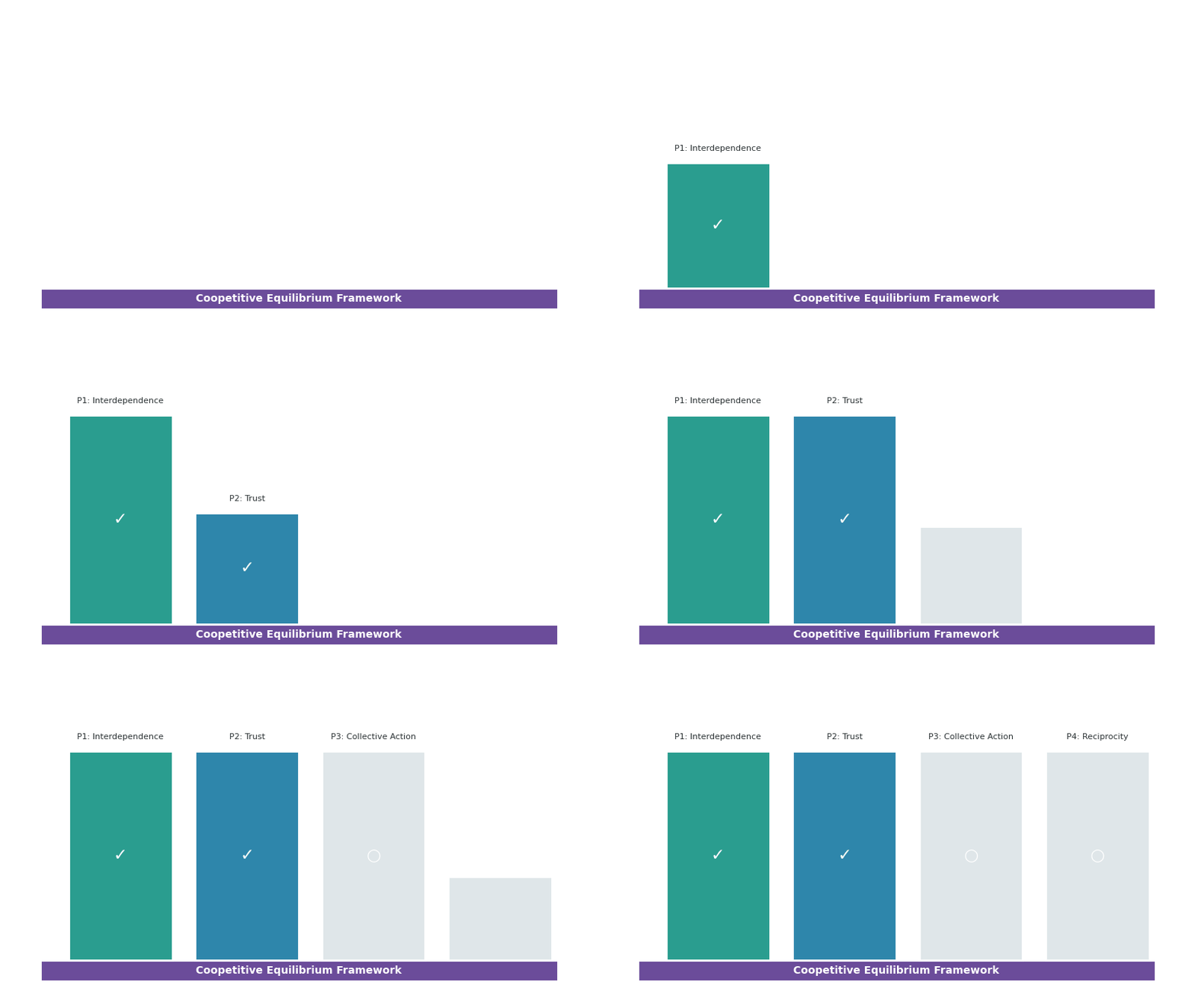
The theoretical foundations are organized into four pillars, all of which are currently implemented:
Implemented Pillars
| Pillar | Technical Report | Focus | Status |
|---|---|---|---|
| 1 | TR-1 (arXiv:2510.18802) | Interdependence & Complementarity | ✓ Implemented |
| 2 | TR-2 (arXiv:2510.24909) | Trust & Reputation Dynamics | ✓ Implemented |
| 3 | TR-3 (arXiv:2601.16237) | Collective Action & Loyalty | ✓ Implemented |
| 4 | TR-4 (arXiv:2604.01240) | Sequential Interaction & Reciprocity | ✓ Implemented |
See Implementation Roadmap for development timeline and planned features.
Theory Documentation
Core Mathematical Framework
| Document | Content | Audience |
|---|---|---|
| Interdependence Framework | Structural dependencies, i* translation, D matrix | Researchers, Advanced Users |
| Value Creation & Complementarity | Value functions, synergy, superadditivity | Researchers, Economists |
| Trust Dynamics | Two-layer trust, asymmetric updating, hysteresis | Researchers, Behavioral Scientists |
| Parameter Reference | Validated values, calibration guidance | All Users |
Quick Reference
For Practitioners seeking to use the environments:
- Start with Parameter Reference for recommended values
- Review Quick Start for implementation patterns
For Researchers seeking to extend the framework:
- Study Interdependence Framework for Pillar 1 foundations
- Study Trust Dynamics for Pillar 2 foundations
- Review original technical reports for complete proofs and derivations
Mathematical Notation
The following notation is used consistently throughout the documentation:
Indices and Sets
| Symbol | Definition |
|---|---|
| $N$ | Number of agents |
| $i, j \in {1, \ldots, N}$ | Agent indices |
| $t \in {0, 1, 2, \ldots}$ | Time period |
| $d \in \mathcal{D}_i$ | Dependum (goal, task, resource) in agent $i$’s goal set |
Actions and Payoffs
| Symbol | Definition | Range |
|---|---|---|
| $a_i$ | Agent $i$’s action (cooperation/investment level) | $[0, e_i]$ |
| $\mathbf{a} = (a_1, \ldots, a_N)$ | Action profile (all agents) | $\prod_i [0, e_i]$ |
| $e_i$ | Agent $i$’s endowment | $\mathbb{R}^+$ |
| $\pi_i(\mathbf{a})$ | Agent $i$’s private payoff | $\mathbb{R}$ |
| $U_i(\mathbf{a})$ | Agent $i$’s integrated utility | $\mathbb{R}$ |
Interdependence (Pillar 1)
| Symbol | Definition | Range |
|---|---|---|
| $D_{ij}$ | Interdependence coefficient ($i$ depends on $j$) | $[0, 1]$ |
| $w_d$ | Importance weight of dependum $d$ | $\mathbb{R}^+$ |
| $\text{Dep}(i,j,d)$ | Dependency indicator (binary) | ${0, 1}$ |
| $\text{crit}(i,j,d)$ | Criticality factor | $[0, 1]$ |
| $\mathbf{D}$ | Interdependence matrix | $[0,1]^{N \times N}$ |
Value Functions (Pillar 1)
| Symbol | Definition | Range |
|---|---|---|
| $V(\mathbf{a} \mid \gamma)$ | Total value created | $\mathbb{R}^+$ |
| $f_i(a_i)$ | Individual value contribution | $\mathbb{R}^+$ |
| $g(a_1, \ldots, a_N)$ | Synergy function | $\mathbb{R}^+$ |
| $\gamma$ | Complementarity parameter | $[0, 1]$ |
| $\theta$ | Logarithmic scale parameter | $\mathbb{R}^+$ |
| $\beta$ | Power function exponent | $(0, 1)$ |
| $\alpha_i$ | Agent $i$’s share of synergistic value | $[0, 1]$ |
Trust Dynamics (Pillar 2)
| Symbol | Definition | Range |
|---|---|---|
| $T_{ij}^t$ | Immediate trust ($i$ toward $j$ at time $t$) | $[0, 1]$ |
| $R_{ij}^t$ | Reputation damage ($j$’s violations from $i$’s view) | $[0, 1]$ |
| $\Theta_{ij}^t$ | Trust ceiling | $[0, 1]$ |
| $s_{ij}^t$ | Cooperation signal | $(-1, 1)$ |
| $\lambda^+$ | Trust building rate | $(0, 1)$ |
| $\lambda^-$ | Trust erosion rate | $(0, 1)$ |
| $\mu_R$ | Reputation damage severity | $(0, 1)$ |
| $\delta_R$ | Reputation decay rate | $(0, 1)$ |
| $\xi$ | Interdependence amplification factor | $[0, 1]$ |
| $\kappa$ | Signal sensitivity | $\mathbb{R}^+$ |
Reciprocity (Pillar 4)
| Symbol | Definition | Range |
|---|---|---|
| $s_{ij}$ | Cooperation signal (deviation from memory average) | $\mathbb{R}$ |
| $\bar{a}_j$ | Memory average of agent $j$’s recent actions | $\mathbb{R}^+$ |
| $\varphi(x)$ | Bounded response function $\tanh(\kappa x)$ | $(-1, 1)$ |
| $\rho_{ij}$ | Reciprocity sensitivity (dependency-scaled) | $\mathbb{R}^+$ |
| $\rho_0$ | Base reciprocity strength | $\mathbb{R}^+$ |
| $\eta$ | Dependency elasticity | $\mathbb{R}^+$ |
| $k$ | Memory window length (steps) | $\mathbb{N}^+$ |
| $\lambda_R$ | Reciprocity weight | $\mathbb{R}^+$ |
| $\omega$ | Dependency amplification in trust gating | $\mathbb{R}^+$ |
Core Equations Summary
Pillar 1: Interdependence & Complementarity
Interdependence Matrix (Equation 1, TR-1):
\[\Large D_{ij} = \frac{\sum_{d \in \mathcal{D}_i} w_d \cdot \text{Dep}(i,j,d) \cdot \text{crit}(i,j,d)}{\sum_{d \in \mathcal{D}_i} w_d}\]Value Creation (Equation 2, TR-1):
\[\Large V(\mathbf{a} \mid \gamma) = \sum_{i=1}^{N} f_i(a_i) + \gamma \cdot g(a_1, \ldots, a_N)\]Logarithmic Individual Value (Equation 6, TR-1):
\[\Large f_i(a_i) = \theta \cdot \ln(1 + a_i) \quad \text{where } \theta = 20.0\]Power Individual Value (Equation 3, TR-1):
\[\Large f_i(a_i) = a_i^{\beta} \quad \text{where } \beta = 0.75\]Geometric Mean Synergy (Equation 4, TR-1):
\[\Large g(a_1, \ldots, a_N) = \left(\prod_{i=1}^{N} a_i\right)^{1/N}\]Private Payoff (Equation 11, TR-1):
\[\Large \pi_i(\mathbf{a}) = e_i - a_i + f_i(a_i) + \alpha_i \left[V(\mathbf{a}) - \sum_{j=1}^{N} f_j(a_j)\right]\]Integrated Utility (Equation 13, TR-1):
\[\Large U_i(\mathbf{a}) = \pi_i(\mathbf{a}) + \sum_{j \neq i} D_{ij} \cdot \pi_j(\mathbf{a})\]Pillar 2: Trust Dynamics
Cooperation Signal (Equation 4, TR-2):
\[\Large s_{ij}^t = \tanh\left(\kappa \cdot (a_j^t - a_j^{\text{baseline}})\right)\]Trust Evolution (Equation 5, TR-2):
\[\Large T_{ij}^{t+1} = T_{ij}^t + \Delta T_{ij}^t\]where:
\[\Delta T_{ij}^t = \begin{cases} \lambda^+ \cdot s \cdot (\Theta - T) & \text{if } s > 0 \text{ (building)} \\ -\lambda^- \cdot |s| \cdot T \cdot (1 + \xi \cdot D_{ij}) & \text{if } s \leq 0 \text{ (erosion)} \end{cases}\]Trust Ceiling (Equation 7, TR-2):
\[\Large \Theta_{ij}^t = 1 - R_{ij}^t\]Reputation Evolution (Equation 8, TR-2):
\[\Large R_{ij}^{t+1} = R_{ij}^t + \Delta R_{ij}^t - \delta_R \cdot R_{ij}^t\]where:
\[\Delta R_{ij}^t = \begin{cases} \mu_R \cdot |s| \cdot (1 - R) & \text{if } s < 0 \text{ (damage)} \\ 0 & \text{if } s \geq 0 \text{ (no damage)} \end{cases}\]Pillar 4: Reciprocity Dynamics
Cooperation Signal (Equation 19, TR-4):
\[\Large s_{ij} = a_j - \bar{a}_j\]where $\bar{a}_j$ is the memory average over the last $k$ steps.
Memory Average (Equation 20, TR-4):
\[\Large \bar{a}_j = \frac{1}{\min(k, t-1)} \sum_{\tau=\max(1,t-k)}^{t-1} a_j^\tau\]Bounded Response (Equation 21, TR-4):
\[\Large \varphi(x) = \tanh(\kappa \cdot x)\]Reciprocity Sensitivity (Equation 23, TR-4):
\[\Large \rho_{ij} = \rho_0 \cdot D_{ij}^{\eta}\]Reciprocity Modifier (Equation 44, TR-4):
\[\Large U_{\text{recip},i} = \lambda_R \sum_{j \neq i} T_{ij} \cdot (1 + \omega D_{ij}) \cdot \rho_{ij} \cdot \varphi(s_{ij})\]Validation Methodology
The framework employs dual-track validation:
Track 1: Experimental Robustness
Systematic parameter sweeps ensure phenomena emerge robustly:
| Validation Set | Configurations | Purpose |
|---|---|---|
| TR-1 Validation | 22,000+ trials | Value function robustness |
| TR-2 Validation | 78,125 configs | Trust dynamics robustness |
| Benchmark Suite | 760 experiments | Algorithm performance |
Track 2: Empirical Case Studies
Real-world validation against documented business partnerships and open source projects:
| Case Study | Period | Validation Score | Dynamics Validated |
|---|---|---|---|
| Samsung-Sony S-LCD | 2004-2011 | 58/60 (96.7%) | Interdependence, complementarity |
| Renault-Nissan Alliance | 1999-2025 | 49/60 (81.7%) | Trust evolution, crisis, recovery |
| Apache HTTP Server | 1995-2023 | 52/60 (86.7%) | Loyalty dynamics, phase transitions |
| Apple iOS App Store | 2008-2024 | 48/55 (87.3%) | Reciprocity dynamics, platform power |
Statistical Significance
| Metric | Value | Interpretation |
|---|---|---|
| p-value | < 0.001 | Highly significant |
| Cohen’s d | 9.87 | Very large effect size |
| Negativity Ratio | 3.0 median | Consistent with behavioral economics |
Theoretical Assumptions
The framework makes the following key assumptions:
Rationality Assumptions
- Bounded Rationality: Agents optimize utility but with limited information
- Forward-Looking: Agents consider future consequences (discount factor β ≈ 0.95)
- Observable Actions: Cooperation levels are observable (no hidden actions)
Structural Assumptions
- Asymmetric Dependencies: $D_{ij} \neq D_{ji}$ in general
- Stable Structure: Interdependence matrix $\mathbf{D}$ is fixed within episodes
- Continuous Actions: Cooperation levels are continuous, not discrete
Trust Assumptions
- Negativity Bias: Trust erodes faster than it builds ($\lambda^- > \lambda^+$)
- Path Dependence: Historical violations constrain future trust (hysteresis)
- Bilateral Trust: $T_{ij} \neq T_{ji}$ (trust is not automatically symmetric)
Limitations
- No Communication: Agents cannot explicitly signal intentions
- No Contracting: No binding commitment mechanisms (Pillar 4 addresses this)
- Homogeneous Agents: Within-agent-type homogeneity assumed
- Western Business Context: Validated primarily on Western partnerships
Citation
If you use the theoretical framework in your research, please cite:
@article{pant2025tr1,
  title={Computational Foundations for Strategic Coopetition: Formalizing Interdependence and Complementarity},
  author={Pant, Vik and Yu, Eric},
  journal={arXiv preprint arXiv:2510.18802},
  year={2025}
}

@article{pant2025tr2,
  title={Computational Foundations for Strategic Coopetition: Formalizing Trust and Reputation Dynamics},
  author={Pant, Vik and Yu, Eric},
  journal={arXiv preprint arXiv:2510.24909},
  year={2025}
}

@article{pant2026tr3,
  title={Computational Foundations for Strategic Coopetition: Formalizing Collective Action and Loyalty},
  author={Pant, Vik and Yu, Eric},
  journal={arXiv preprint arXiv:2601.16237},
  year={2026}
}

@article{pant2026tr4,
  title={Computational Foundations for Strategic Coopetition: Formalizing Sequential Interaction and Reciprocity},
  author={Pant, Vik and Yu, Eric},
  journal={arXiv preprint arXiv:2604.01240},
  year={2026}
}