Implementation Roadmap
Coopetition-Gym Development Trajectory
This document outlines the research-driven development roadmap for Coopetition-Gym, organized around four theoretical pillars derived from the computational foundations for strategic coopetition research program.
Scope Note: This roadmap covers the Foundations series (TR-1 through TR-4), which adopts the uniaxial treatment of coopetition following the social dilemma tradition (Bengtsson & Kock, 2000). Agents choose cooperation levels along a [0, endowment] continuum, with competitive dynamics emerging through structural parameters (interdependence, bargaining shares, trust). For the theoretical rationale, literature justification, and future Extensions roadmap (biaxial treatment with independent cooperation and competition dimensions), see the Scope and Strategic Roadmap.
Research Program Architecture
Coopetition-Gym implements a coordinated research program examining strategic coopetition in multi-agent systems. The program addresses five dimensions of coopetitive relationships through four technical reports:
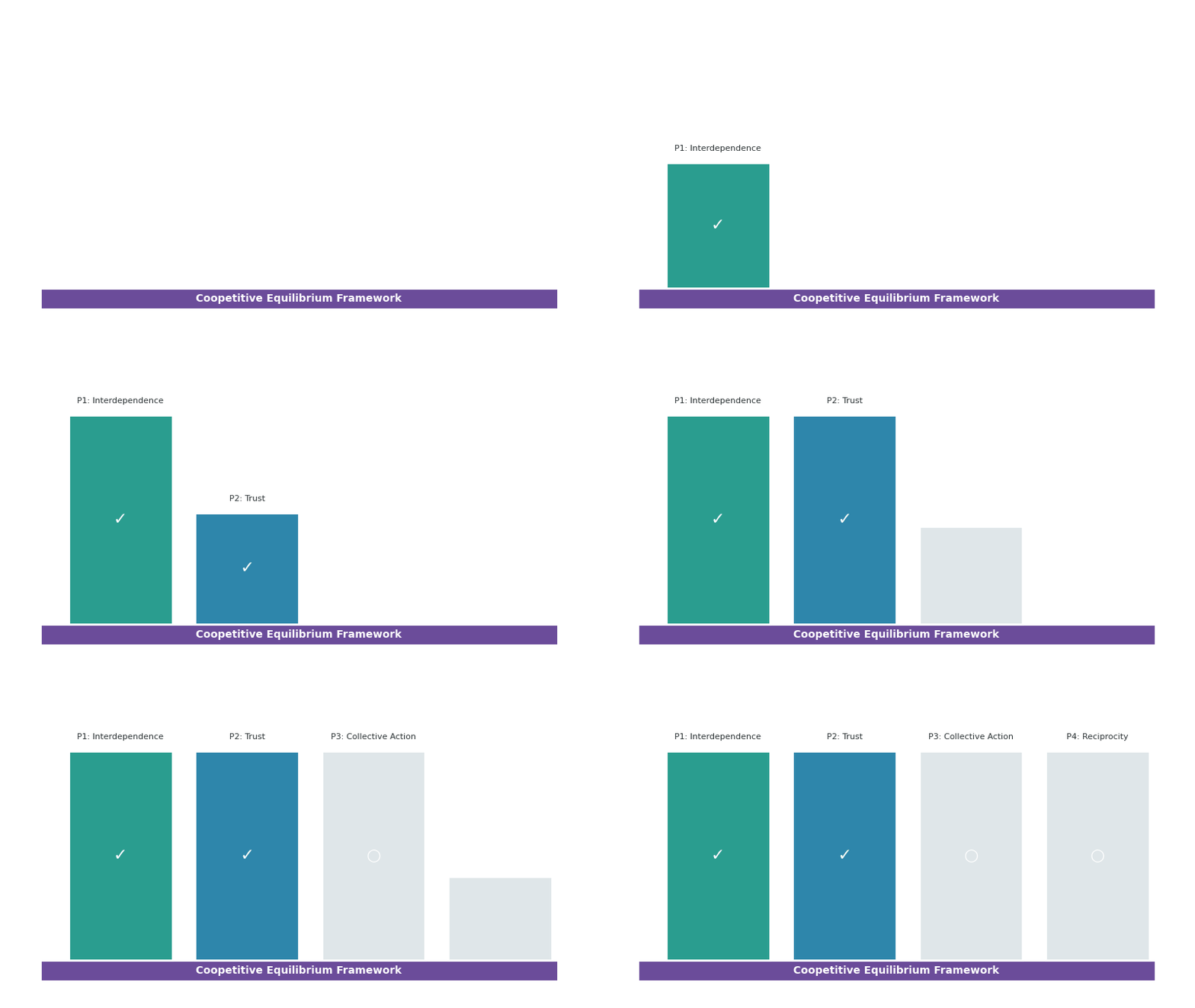
| Pillar | Focus | Technical Report | Status |
|---|---|---|---|
| 1 | Interdependence & Complementarity | TR-1 (arXiv:2510.18802) | ✓ Implemented |
| 2 | Trust & Reputation Dynamics | TR-2 (arXiv:2510.24909) | ✓ Implemented |
| 3 | Collective Action & Loyalty | TR-3 (arXiv:2601.16237) | ✓ Implemented |
| 4 | Sequential Interaction & Reciprocity | TR-4 (arXiv:2604.01240) | ✓ Implemented |
Current Implementation Status
Pillar 1: Interdependence & Complementarity (TR-1, arXiv:2510.18802) ✓
| Status: Fully Implemented | Validation: 58/60 (96.7%) against S-LCD case study |
What’s Implemented:
| Component | Implementation | Validation |
|---|---|---|
| Interdependence Matrix | core/interdependence.py |
22,000+ experimental trials |
| Value Creation Functions | core/value_functions.py |
Logarithmic: θ=20.0 validated |
| Complementarity (Synergy) | Geometric mean specification | γ=0.65 multi-criteria optimal |
| Integrated Utility | core/equilibrium.py |
Dependency-weighted payoffs |
| Coopetitive Equilibrium | Nash with structural coupling | Proven existence conditions |
Key Equations in Code:
# Interdependence Matrix (Equation 1 from TR-1)
D_ij = Σ(w_d × Dep(i,j,d) × crit(i,j,d)) / Σw_d

# Value Creation with Complementarity (Equation 2 from TR-1)
V(a|γ) = Σ f_i(a_i) + γ × g(a_1, ..., a_N)

# Integrated Utility (Equation 13 from TR-1)
U_i(a) = π_i(a) + Σ D_ij × π_j(a)
Empirical Validation:
- Samsung-Sony S-LCD Joint Venture (2004-2011)
- Logarithmic specification achieves 58/60 accuracy
- Power specification achieves 46/60 accuracy
- Statistical significance: p < 0.001, Cohen’s d = 9.87
Pillar 2: Trust & Reputation Dynamics (TR-2, arXiv:2510.24909) ✓
| Status: Fully Implemented | Validation: 49/60 (81.7%) against Renault-Nissan case study |
What’s Implemented:
| Component | Implementation | Validation |
|---|---|---|
| Immediate Trust (T) | core/trust_dynamics.py |
Two-layer architecture |
| Reputation Damage (R) | Memory of violations | 78,125 parameter configs |
| Asymmetric Updating | 3:1 negativity bias | Behavioral economics aligned |
| Trust Ceiling | Θ = 1 - R | Hysteresis effects confirmed |
| Interdependence Amplification | (1 + ξ × D_ij) factor | 27% faster erosion at high D |
Key Equations in Code:
# Cooperation Signal (Equation 4 from TR-2)
s_ij = tanh(κ × (a_j - baseline))

# Trust Building (Equation 5 from TR-2)
ΔT = λ⁺ × signal × (ceiling - T) × Θ    # when signal > 0

# Trust Erosion (Equation 5 from TR-2)
ΔT = -λ⁻ × |signal| × T × (1 + ξ × D_ij)  # when signal ≤ 0

# Trust Ceiling (Equation 7 from TR-2)
Θ = min(T_max, 1.0 - θ × R)
Validated Parameters:
| Parameter | Symbol | Validated Value | Source |
|---|---|---|---|
| Trust Building Rate | λ⁺ | 0.10 | TR-2 §7.2 |
| Trust Erosion Rate | λ⁻ | 0.30 | TR-2 §7.2 |
| Negativity Ratio | λ⁻/λ⁺ | 3.0 | Behavioral economics |
| Reputation Damage | $\mu_R$ | 0.60 | TR-2 §7.3 |
| Reputation Decay | $\delta_R$ | 0.03 | TR-2 §7.3 |
| Interdep. Amplification | ξ | 0.50 | TR-2 §7.4 |
Empirical Validation:
- Renault-Nissan Alliance (1999-2025)
- Five distinct relationship phases modeled
- Crisis and recovery dynamics captured
- 78,125 parameter configurations tested
Pillar 3: Collective Action & Loyalty (TR-3, arXiv:2601.16237) ✓
| Status: Fully Implemented | Validation: 52/60 (86.7%) against Apache HTTP Server case study |
What’s Implemented:
| Component | Implementation | Validation |
|---|---|---|
| Team Structure | envs/collective_action_envs.py |
N-player team production |
| Free-Riding Problem | Nash equilibrium computation | Universal shirking baseline |
| Loyalty Parameter | θ ∈ [0,1] per agent | Four synergistic mechanisms |
| Cost Tolerance | φ_C = 0.3 default | Perceived cost reduction |
| Welfare Internalization | φ_B = 0.8 default | Teammate payoff bonus |
| Coalition Dynamics | Entry/exit with exclusion | Minimum coalition size |
| Phase-Based Teams | ApacheProject-v0 phases | 4 historical phases |
Key Equations in Code:
# Team Production Function (Equation from TR-3)
Q(a) = ω × (Σa_i)^β

# Loyalty Modifier (Equation from TR-3)
L_i = θ_i × [φ_B × π̄_{-i} + φ_C × c × a_i]

# Loyalty-Augmented Utility
U_i = π_i^{team} + L_i
Validated Results:
- Apache HTTP Server case study (1995-2023): 52/60 validation score
- 4.12× effort differentiation (high vs low loyalty contributors)
- Phase-appropriate loyalty patterns across project lifecycle
- Free-riding baseline matches theoretical equilibrium (99.7%)
Environments Implemented:
| Environment | Description | Key Feature |
|---|---|---|
| TeamProduction-v0 | Baseline free-rider dynamics | Nash equilibrium reference |
| LoyaltyTeam-v0 | Full TR-3 loyalty mechanisms | Above-Nash cooperation |
| CoalitionFormation-v0 | Dynamic coalition with exclusion | Entry/exit dynamics |
| ApacheProject-v0 | Validated 4-phase case study | 52/60 validation score |
| PublicGoods-v0 | Classic public goods game | Contribution dynamics |
Pillar 4: Sequential Interaction & Reciprocity (TR-4, arXiv:2604.01240) ✓
| Status: Fully Implemented | Environments: 5 | Validation: 48/55 (87.3%) against Apple App Store case study |
Implemented Components:
| Component | Description | Mathematical Basis |
|---|---|---|
| Bounded Response Function | Finite reactions to deviations | $\varphi_{\text{recip}}(x) = \tanh(\kappa_{\text{recip}} \times x)$ |
| Memory-Windowed History | Bounded rationality ($k$ periods) | $\bar{a}_j = (1/k) \times \sum a_j^\tau$ |
| Reciprocity Sensitivity | Structural dependency grounding | $\rho_{ij} = \rho_0 \times D_{ij}^\eta$ |
| Trust-Gated Reciprocity | Trust modulates response | $T_{ij} \times \rho_{ij} \times R_{ij}$ |
| Sequential Cooperation | History-dependent strategies | $\sigma_i: H \rightarrow A_i$ |
Planned Equations:
# Reciprocity Response (planned)
R_ij(a, h) = ρ_ij × φ_recip(a_j - ā_j)

# Structural Reciprocity Sensitivity (planned)
ρ_ij = ρ_0 × D_ij^η

# Trust-Gated Utility Extension (planned)
U_i(a, T) = U_base + Σ λ_T × T_ij × (1 + ω×D_ij) × ρ_ij × R_ij
Expected Validation:
- 4× differentiated responses under asymmetric dependencies
- Memory window effects on forgiveness dynamics
- Trust-reciprocity interaction validation
- Perfect Bayesian Equilibrium characterization
Use Cases:
- Sequential negotiation scenarios
- Reputation-based partner selection
- Long-term alliance management
- Crisis recovery coordination
Environment Roadmap by Pillar
Currently Available (Pillars 1, 2 & 3)
TR-1 Interdependence & Complementarity Environments (5):
| Environment | Primary Focus | Secondary Pillar |
|---|---|---|
| PartnerHoldUp-v0 | Asymmetric Interdependence | Trust (P2) |
| PlatformEcosystem-v0 | Ecosystem Complementarity | Trust (P2) |
| DynamicPartnerSelection-v0 | Partner Value Creation | Trust (P2) |
| SynergySearch-v0 | Hidden Complementarity (γ) | — |
| RenaultNissan-v0 | Alliance Interdependence | Trust (P2) |
TR-2 Trust & Reputation Dynamics Environments (5):
| Environment | Primary Focus | Secondary Pillar |
|---|---|---|
| TrustDilemma-v0 | Trust Evolution | Interdependence (P1) |
| RecoveryRace-v0 | Trust Recovery | — |
| SLCD-v0 | Trust Model (Validated 58/60) | Interdependence (P1) |
| CooperativeNegotiation-v0 | Commitment & Breach | Complementarity (P1) |
| ReputationMarket-v0 | Reputation Dynamics | — |
TR-3 Collective Action & Loyalty Environments (5):
| Environment | Primary Pillar | Secondary Pillar |
|---|---|---|
| TeamProduction-v0 | Loyalty (P3) | — |
| LoyaltyTeam-v0 | Loyalty (P3) | — |
| CoalitionFormation-v0 | Loyalty (P3) | — |
| ApacheProject-v0 | Loyalty (P3) | — |
| PublicGoods-v0 | Loyalty (P3) | — |
Implemented Environments (Pillar 4)
| Environment | Primary Pillar | Description |
|---|---|---|
| ReciprocalDilemma-v0 | Reciprocity (P4) | Direct reciprocity via bounded memory |
| GiftExchange-v0 | Reciprocity (P4) | Asymmetric employer-worker reciprocity |
| IndirectReciprocity-v0 | Reciprocity (P4) | Reputation-mediated cooperation |
| GraduatedSanction-v0 | Reciprocity (P4) | Proportional sanctions with escalation |
| AppleAppStore-v0 | Reciprocity (P4) | Validated case study (48/55) |
Implementation Timeline
| Period | Milestone | Deliverables | Status |
|---|---|---|---|
| 2025 Q1-Q2 | Pillars 1 & 2 Implementation | Core mathematical framework, 10 base environments, S-LCD & Renault-Nissan validation | ✓ Complete |
| 2025 Q3 | Benchmark Suite | 20 algorithm evaluation, 760 experiments (76,000 episodes), comprehensive documentation | ✓ Complete |
| 2025 Q4 | Theory Documentation | theory/ documentation subdirectory, parameter reference guide, research insights | ✓ Complete |
| 2026 Q1 | Pillar 3 Implementation | 5 TR-3 collective action environments, Apache case study (52/60), loyalty mechanisms | ✓ Complete |
| 2026 Q1 | Pillar 4 Implementation | 5 TR-4 reciprocity environments, Apple App Store case study (48/55), reciprocity dynamics | ✓ Complete |
| 2026 Q3 | Integration & Validation | Cross-pillar environment combinations, extended benchmark suite, multi-level dynamics | Planned |
Contributing to the Roadmap
We welcome contributions aligned with the research program:
High-Priority Contributions
- Algorithm Implementations: MARL algorithms optimized for coopetitive dynamics
- Environment Extensions: New scenarios within Pillars 1-2 framework
- Validation Studies: Empirical case studies for parameter calibration
- Documentation: Tutorials, examples, and theoretical exposition
Future Research Directions
- Multi-Level Dynamics: How team loyalty (P3) interacts with inter-team trust (P2)
- Learning in Coopetition: Algorithms that discover cooperative equilibria
- Mechanism Design: Incentive structures promoting sustainable coopetition
- Empirical Calibration: Additional real-world case study validation
How to Contribute
See Contributing Guide for:
- Code contribution guidelines
- Documentation standards
- Testing requirements
- Review process
References
Published Technical Reports
-
Pant, V. & Yu, E. (2025). Computational Foundations for Strategic Coopetition: Formalizing Interdependence and Complementarity. arXiv:2510.18802
-
Pant, V. & Yu, E. (2025). Computational Foundations for Strategic Coopetition: Formalizing Trust and Reputation Dynamics. arXiv:2510.24909
-
Pant, V. & Yu, E. (2025). Computational Foundations for Strategic Coopetition: Formalizing Collective Action and Loyalty. arXiv:2601.16237
-
Pant, V. & Yu, E. (2026). Computational Foundations for Strategic Coopetition: Formalizing Sequential Interaction and Reciprocity. arXiv:2604.01240
Foundational Work
-
Pant, V. (2021). A Conceptual Modeling Framework for Strategic Coopetition. Doctoral Dissertation, University of Toronto
-
Brandenburger, A. M. & Nalebuff, B. J. (1996). Co-opetition. Currency Doubleday