Value Creation & Complementarity
Formalizing Synergistic Value in Strategic Coopetition (TR-1)
This document provides a comprehensive treatment of value creation and complementarity from Technical Report 1 (TR-2025-01), explaining how cooperative surplus emerges and is modeled mathematically.
Executive Summary
For Practitioners: Complementarity explains why cooperation creates value, joint action produces more than the sum of independent efforts. When Samsung and Sony combined manufacturing expertise with brand strength, they created value neither could achieve alone.
| For Researchers: We formalize complementarity through value creation functions V(a | γ) exhibiting superadditivity. Two specifications (logarithmic, power) are validated, with logarithmic achieving 58/60 accuracy on the S-LCD case study. The complementarity parameter γ controls synergy strength. |
Conceptual Foundation
The Value Creation Problem
In coopetition, actors face a fundamental tension:
- Cooperate to create more total value (grow the pie)
- Compete to capture a larger share of that value (split the pie)
This is the essence of Brandenburger and Nalebuff’s coopetition framework: actors must balance value creation incentives against value appropriation incentives.
What is Complementarity?
Definition: Complementarity exists when joint action creates superadditive value, the whole exceeds the sum of the parts.
Mathematically:
\[\Large V(\{i, j\}) > V(\{i\}) + V(\{j\})\]The value created by actors $i$ and $j$ working together exceeds what each could create independently.
Sources of Complementarity
| Source | Mechanism | Example |
|---|---|---|
| Resource Combination | Heterogeneous assets synergize | Manufacturing + Brand |
| Knowledge Spillovers | Learning from partner | Technology transfer |
| Network Effects | Combined networks exceed sum | User base combination |
| Risk Sharing | Diversification benefits | Joint investment |
| Economies of Scale | Combined volume reduces cost | Joint purchasing |
The Added Value Concept
Following Brandenburger and Nalebuff, we define an actor’s Added Value as:
\[\Large \text{Added Value}_i = V(\text{all actors}) - V(\text{all actors except } i)\]Actors with high added value have strong bargaining positions because the coalition loses significant value without them. Complementarity increases added value for all participants.
Mathematical Formalization
The Value Creation Function
Equation 2 (TR-1): Total value created by joint action:
\[\Large V(\mathbf{a} \mid \gamma) = \sum_{i=1}^{N} f_i(a_i) + \gamma \cdot g(a_1, \ldots, a_N)\]Components:
| Component | Symbol | Meaning |
|---|---|---|
| Individual Value | $f_i(a_i)$ | Value actor $i$ creates independently |
| Synergy Function | $g(a_1,\ldots,a_N)$ | Value existing only through collaboration |
| Complementarity | γ ∈ [0, 1] | Strength of synergistic effects |
Individual Value Functions
Individual value represents what each actor contributes independently of collaboration. Two specifications are validated:
Logarithmic Specification (Recommended)
Equation 6 (TR-1):
\[\Large f_i(a_i) = \theta \cdot \ln(1 + a_i) \quad \text{where } \theta = 20.0\]Properties:
- Strictly increasing: more action → more value
- Diminishing returns: first unit more valuable than last
- Bounded growth: prevents runaway predictions
- Initial slope = θ (steep initial returns)
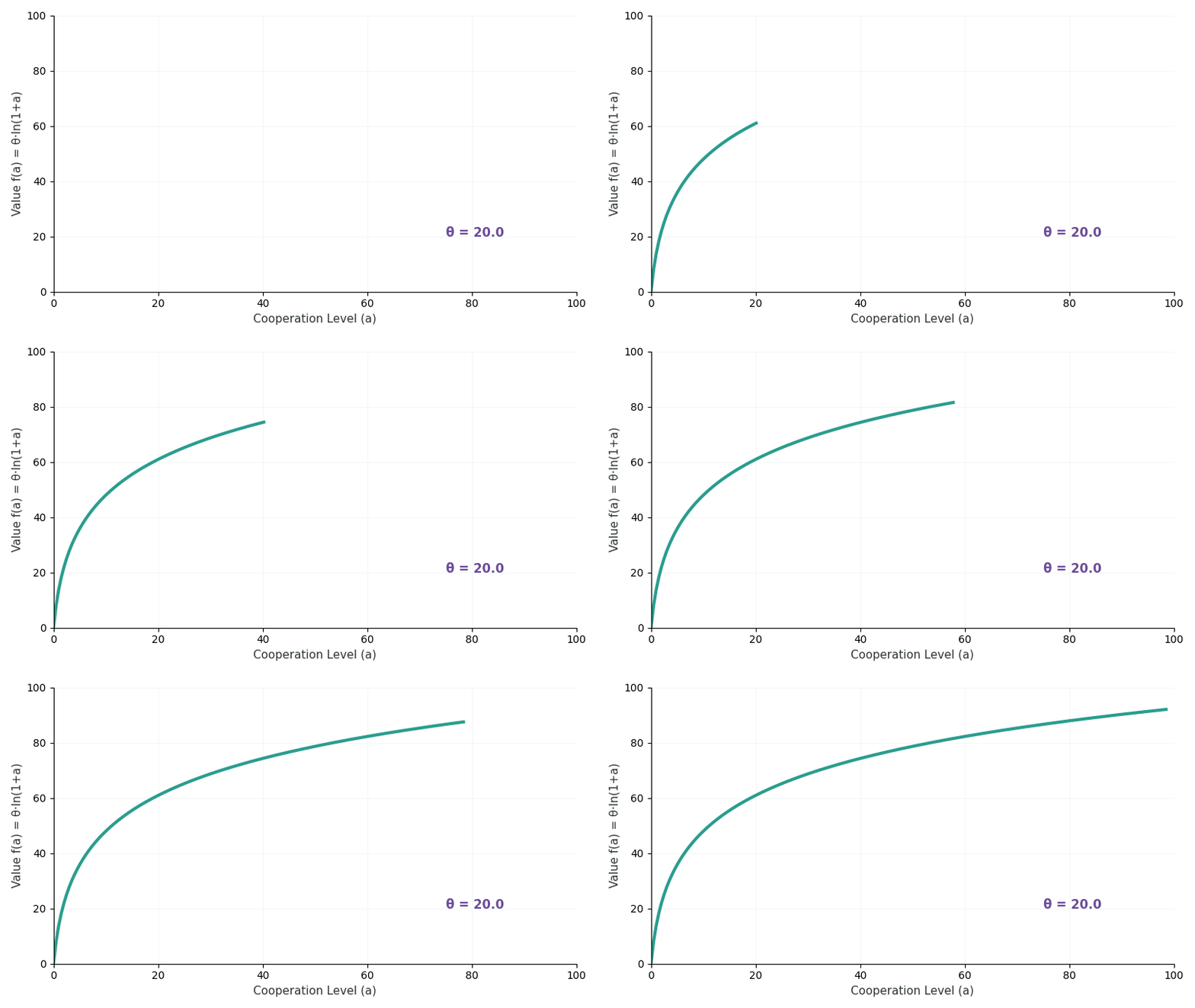
When to Use: Manufacturing partnerships, technology joint ventures, scenarios where baseline capabilities are highly valuable but incremental improvements have declining impact.
Power Specification (Alternative)
Equation 3 (TR-1):
\[\Large f_i(a_i) = a_i^{\beta} \quad \text{where } \beta = 0.75\]Properties:
- Strictly increasing
- Diminishing returns (β < 1)
- Unbounded growth (can produce large values)
- Cobb-Douglas production function tradition
When to Use: General scenarios, platform ecosystems, academic baselines.
Synergy Function
The synergy function captures value that exists only through collaboration, it requires multiple actors contributing.
Equation 4 (TR-1): Geometric Mean
\[\Large g(a_1, \ldots, a_N) = \left(\prod_{i=1}^{N} a_i\right)^{1/N}\]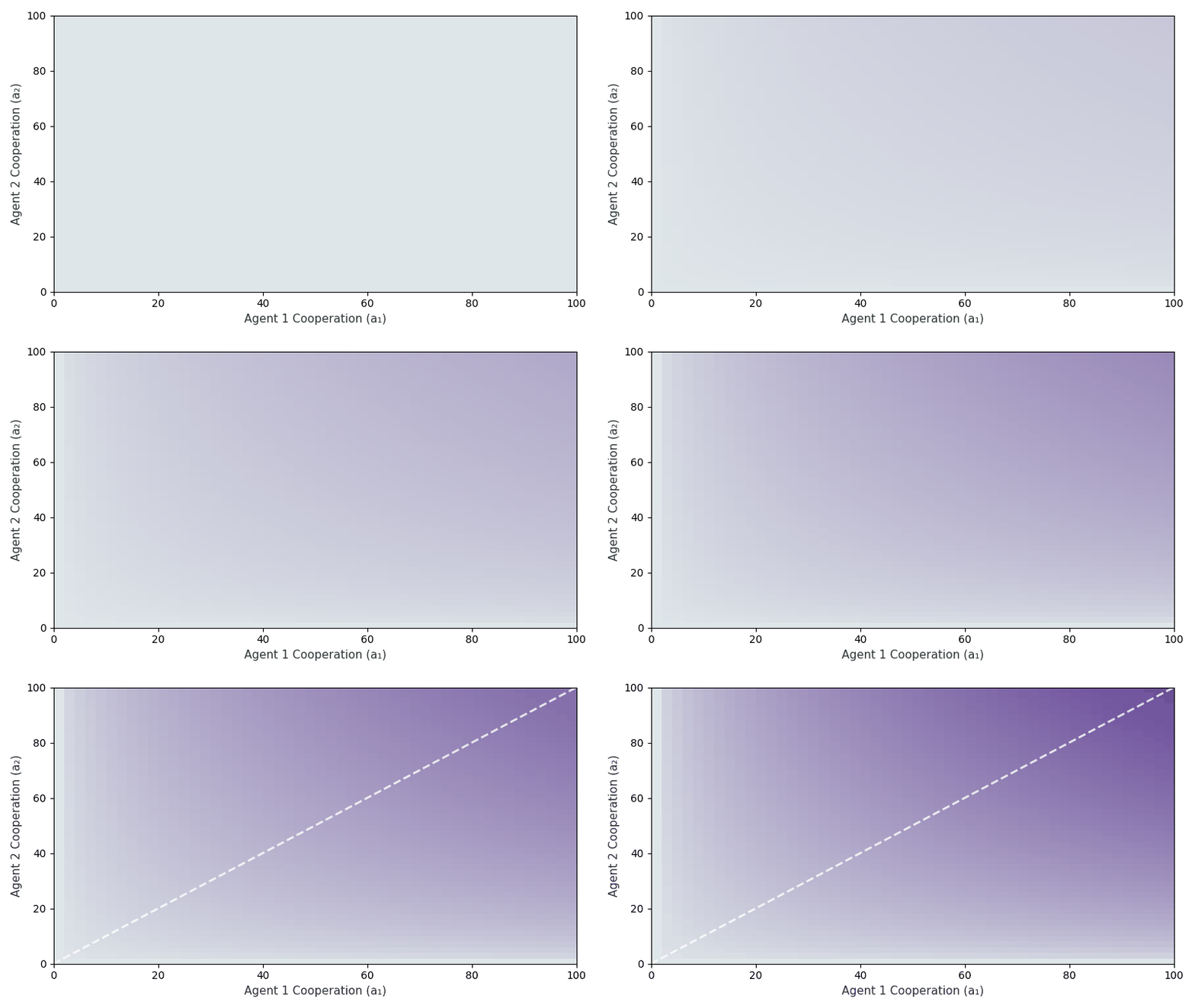
For Two Actors:
\[\Large g(a_1, a_2) = \sqrt{a_1 \cdot a_2}\]Properties:
| Property | Description | Implication |
|---|---|---|
| Symmetric | Order doesn’t matter | Fair contribution accounting |
| Zero-requiring | If any $a_i = 0$, $g = 0$ | All must contribute |
| Balance-rewarding | Maximized when $a_i$ equal | Discourages free-riding |
| Smooth | Continuous and differentiable | Tractable optimization |
Why Geometric Mean?
The geometric mean captures the intuition that:
- Everyone must contribute: A single defector ($a_i = 0$) destroys all synergy
- Balance matters: 50-50 contribution creates more synergy than 90-10
- Scale invariance: Synergy scales appropriately with contribution size
Alternative Synergy Functions (not implemented, for reference):
| Function | Formula | Properties |
|---|---|---|
| Arithmetic Mean | $\sum a_i / N$ | Weak complementarity, tolerates defection |
| Minimum | $\min(a_i)$ | Leontief production, bottleneck-limited |
| Cobb-Douglas | $\prod a_i^{\alpha_i}$ | Asymmetric weights possible |
The Complementarity Parameter ($\gamma$)
Range: $\gamma \in [0, 1]$
Interpretation:
| γ Value | Interpretation | Environment Behavior |
|---|---|---|
| 0.0 | No complementarity | Purely additive value; no synergy benefit |
| 0.3 | Weak complementarity | Modest cooperation incentive |
| 0.5 | Moderate complementarity | Balanced individual/joint value |
| 0.65 | Validated default | S-LCD case study calibration |
| 0.8 | Strong complementarity | Substantial cooperation incentive |
| 1.0 | Maximum complementarity | Synergy dominates individual value |
Validated Value: $\gamma = 0.65$ achieves optimal multi-criteria performance across experimental validation (TR-1 §7.2).
Superadditivity Verification
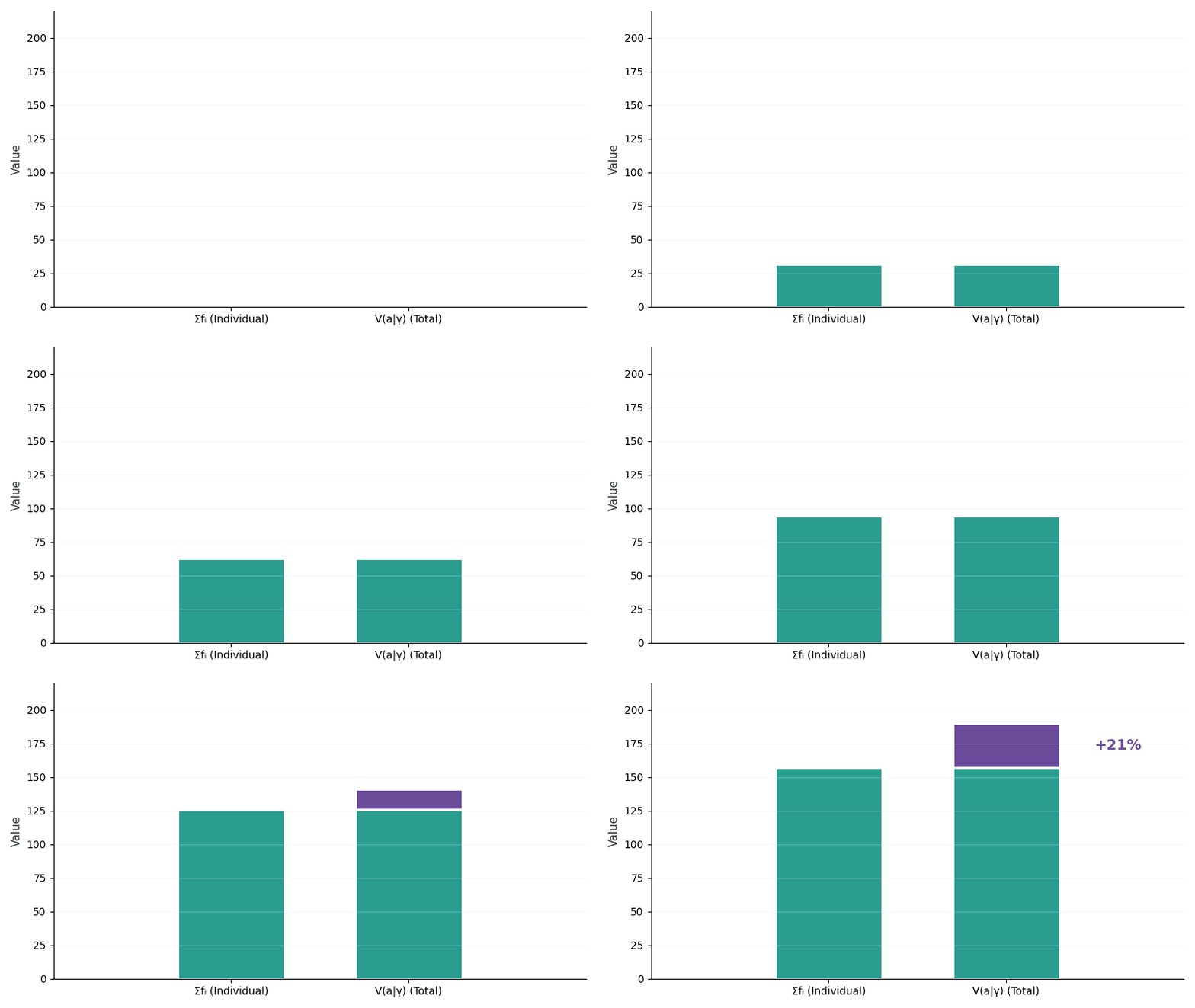
Proving Complementarity Creates Value
| To verify that $V(\mathbf{a} | \gamma)$ exhibits superadditivity, consider two actors choosing actions $(a_1, a_2)$. |
Joint Value (power specification):
\[\Large V(\{a_1, a_2\}) = a_1^{\beta} + a_2^{\beta} + \gamma \sqrt{a_1 \cdot a_2}\]Independent Values:
\[V(\{a_1\}) = a_1^{\beta} \quad \text{and} \quad V(\{a_2\}) = a_2^{\beta}\]Superadditivity Condition:
\[V(\{a_1, a_2\}) > V(\{a_1\}) + V(\{a_2\})\] \[\Leftrightarrow a_1^{\beta} + a_2^{\beta} + \gamma \sqrt{a_1 \cdot a_2} > a_1^{\beta} + a_2^{\beta}\] \[\Leftrightarrow \gamma \sqrt{a_1 \cdot a_2} > 0\]This holds for any $\gamma > 0$ and positive actions, confirming superadditivity. The synergy term $\gamma \sqrt{a_1 \cdot a_2}$ represents Added Value from collaboration.
Quantifying Added Value
Example: Both actors invest 50 units, $\gamma = 0.65$, $\theta = 20$
Logarithmic Specification:
| Component | Formula | Result |
|---|---|---|
| Individual values | $f_1(50) = 20 \cdot \ln(51)$ | 78.64 |
| $f_2(50) = 20 \cdot \ln(51)$ | 78.64 | |
| Synergy | $g(50, 50) = \sqrt{50 \times 50}$ | 50 |
| Synergy value | $0.65 \times 50$ | 32.50 |
| Total value | $V = 78.64 + 78.64 + 32.50$ | 189.78 |
| Added Value | $189.78 - (78.64 + 78.64)$ | 32.50 (17% increase) |
Value Appropriation
The Private Payoff Function
Value creation determines how much total value exists. Value appropriation determines who gets it.
Equation 11 (TR-1):
\[\Large \pi_i(\mathbf{a}) = e_i - a_i + f_i(a_i) + \alpha_i \left[V(\mathbf{a}) - \sum_{j=1}^{N} f_j(a_j)\right]\]Components:
| Term | Formula | Meaning |
|---|---|---|
| Endowment | e_i | Initial resources before interaction |
| Investment Cost | -a_i | Resources committed to partnership |
| Individual Return | f_i(a_i) | Return from own contribution |
| Synergy Share | $\alpha_i$ × Synergy | Share of collaborative surplus |
Synergy = Collaborative Surplus
The synergy being divided is:
\[\Large \text{Synergy} = V(\mathbf{a}) - \sum_{j=1}^{N} f_j(a_j) = \gamma \cdot g(a_1, \ldots, a_N)\]This is the Added Value from collaboration, value that exists only because actors worked together.
Bargaining and Shares ($\alpha_i$)
Constraint: $\Sigma\alpha_i = 1$ (all synergy must be allocated)
Determination Methods: 1. Equal Shares: $\alpha_i = 1/N$ (symmetric bargaining)
- Shapley Value: $\alpha_i$ based on marginal contribution
- Nash Bargaining: $\alpha_i$ reflects relative bargaining power
- Contractual: Pre-negotiated based on relationship structure
Connection to Interdependence: Actors with strong bargaining positions (low dependency, high alternatives) typically secure larger $\alpha_i$. See Interdependence Framework.
Specification Comparison
Experimental Validation
Both specifications were validated against the Samsung-Sony S-LCD joint venture (TR-1 §7-8):
| Criterion | Logarithmic (θ=20) | Power (β=0.75) | Winner |
|---|---|---|---|
| Overall Validation | 58/60 (96.7%) | 46/60 (76.7%) | Logarithmic |
| Historical Alignment | 16/16 | 12/16 | Logarithmic |
| Cooperation Prediction | 41% increase | 166% increase | Logarithmic |
| Bounded Predictions | Yes | No | Logarithmic |
| Mathematical Tractability | Moderate | High | Power |
Why Logarithmic Wins Empirically
The logarithmic specification produces cooperation increases (41%) within the documented S-LCD range (15-50%), while the power specification produces increases (166%) exceeding realistic bounds.
Key Insight: The logarithmic function’s bounded growth prevents runaway predictions that don’t match real-world partnership dynamics.
When to Use Each
| Scenario | Recommended | Rationale |
|---|---|---|
| Manufacturing JV | Logarithmic | Bounded returns, validated |
| Technology partnership | Logarithmic | Diminishing returns realistic |
| Platform ecosystem | Either | Power may be simpler |
| Academic baseline | Power | Cobb-Douglas tradition |
| Sensitivity analysis | Both | Compare robustness |
Implementation Details
Code Correspondence
The value functions are implemented in coopetition_gym/core/value_functions.py:
# Logarithmic individual value
def logarithmic_individual_value(action, theta=20.0): return theta * np.log(1 + action)

# Power individual value
def power_individual_value(action, beta=0.75): return action ** beta

# Geometric mean synergy
def geometric_mean_synergy(actions): return np.prod(actions) ** (1 / len(actions))

# Total value
def total_value(actions, gamma=0.65, theta=20.0): individual = sum(logarithmic_individual_value(a, theta) for a in actions)
    synergy = gamma * geometric_mean_synergy(actions)
    return individual + synergy
Parameter Configuration
import coopetition_gym

# Using logarithmic specification (default)
env = coopetition_gym.make("TrustDilemma-v0",
    theta=20.0,      # Logarithmic scale
    gamma=0.65,      # Complementarity
)

# Using power specification
env = coopetition_gym.make("TrustDilemma-v0",
    value_spec="power",
    beta=0.75,       # Power exponent
    gamma=0.65,      # Complementarity
)
Equilibrium Implications
How Complementarity Affects Equilibrium
Higher γ (more complementarity) shifts equilibrium toward:
- More cooperation: Larger synergy rewards joint action
- Higher total value: More surplus to divide
- Mutual benefit: Both actors gain from cooperation
Complementarity and Trust
Complementarity interacts with trust dynamics (TR-2): 1. High γ creates incentive to cooperate → builds trust
- Built trust enables more cooperation → realizes synergy
- Realized synergy reinforces cooperative equilibrium
This creates a virtuous cycle when γ is high and a vicious cycle when γ is low.
Benchmark Evidence
From 760 experiments (76,000 episodes):
| γ Level | Mean Cooperation | Mean Trust | Mean Return |
|---|---|---|---|
| 0.50 | 42.3% | 41.8% | 34,521 |
| 0.65 | 52.1% | 54.3% | 47,832 |
| 0.80 | 61.4% | 67.2% | 58,947 |
Insight: Higher complementarity produces more cooperative outcomes, higher trust, and higher returns.
Practical Applications
For Partnership Design
- Identify Complementary Assets: What unique capabilities does each partner bring?
- Quantify Synergy Potential: Estimate γ based on asset complementarity
- Structure Value Sharing: Set $\alpha_i$ to sustain cooperation incentives
For Environment Customization
# High-complementarity scenario (technology partnership)
high_comp_env = coopetition_gym.make("TrustDilemma-v0",
    gamma=0.80,  # Strong synergy
    theta=25.0,  # Higher value scale
)

# Low-complementarity scenario (commodity market)
low_comp_env = coopetition_gym.make("TrustDilemma-v0",
    gamma=0.35,  # Weak synergy
    theta=15.0,  # Lower value scale
)
For Research
- Complementarity Effects: How does γ affect algorithm performance?
- Value Function Comparison: Do results differ across specifications?
- Synergy Discovery: Can algorithms find cooperative equilibria?
Further Reading
Primary Source
- Pant, V. & Yu, E. (2025). Computational Foundations for Strategic Coopetition: Formalizing Interdependence and Complementarity. arXiv:2510.18802, Sections 4.2-4.3, 7
Background
- Brandenburger, A. & Nalebuff, B. (1996). Co-opetition. Currency Doubleday
- Shapley, L. (1953). A Value for n-Person Games. Contributions to the Theory of Games
Related Theory Documents
Navigation
- Theoretical Foundations
- Interdependence Framework
- Trust Dynamics
- Parameter Reference
- Environment Reference
Technical Reports
- TR-1: Computational Foundations for Strategic Coopetition: Formalizing Interdependence and Complementarity (arXiv:2510.18802)
- TR-2: Computational Foundations for Strategic Coopetition: Formalizing Trust and Reputation Dynamics (arXiv:2510.24909)
- TR-3: Computational Foundations for Strategic Coopetition: Formalizing Collective Action and Loyalty (arXiv:2601.16237)
- TR-4: Computational Foundations for Strategic Coopetition: Formalizing Sequential Interaction and Reciprocity (arXiv:2604.01240)