Interdependence Framework
Formalizing Structural Dependencies for Strategic Coopetition (TR-1)
This document provides a comprehensive treatment of the interdependence formalization from Technical Report 1 (TR-2025-01), explaining how structural dependencies from conceptual models translate to quantitative game-theoretic analysis.
Executive Summary
For Practitioners: Interdependence captures why actors must consider partner outcomes even while competing. When your success depends on your partner’s success, you have rational incentive to care about their performance, not from altruism, but from structural necessity.
For Researchers: We formalize interdependence through translation from i* dependency networks to an interdependence matrix $\mathbf{D}$, where $D_{ij} \in [0,1]$ quantifies the structural coupling of actor $i$’s outcomes to actor $j$’s actions. This enables game-theoretic equilibrium analysis with dependency-augmented utility functions.
Conceptual Foundation
The Interdependence Problem
Classical game theory assumes purely self-interested payoffs: each actor maximizes their own returns without intrinsic concern for others. This fails to capture a fundamental aspect of real organizational relationships:
Structural Dependency Creates Rational Concern for Partner Outcomes
When Actor A depends on Actor B for critical resources, capabilities, or goal achievement:
- A’s success structurally requires B’s success
- A has rational incentive to care about B’s performance
- This concern is instrumental, not altruistic
Example: A startup developing for iOS cannot succeed if Apple’s App Store fails. The startup rationally cares about Apple’s platform health, not from goodwill, but because their business depends on it.
Distinguishing Interdependence from Altruism
| Concept | Source | Motivation | Varies With |
|---|---|---|---|
| Interdependence | Structural coupling | Instrumental self-interest | Dependency structure |
| Altruism | Psychological preference | Concern for others’ welfare | Personal values |
| Reciprocity | Behavioral response | Conditional cooperation | Partner behavior |
Interdependence is structural: it emerges from how goals and capabilities connect, not from psychological disposition. Two actors with identical personalities will have different interdependence coefficients based on their positions in the dependency network.
The i* Framework Foundation
Strategic Dependency Modeling
The i* framework (Yu, 1995) provides the conceptual basis for interdependence analysis through its representation of strategic actors and dependencies.
Core Elements:
| Element | Symbol | Definition |
|---|---|---|
| Actor | Circle | Intentional entity with goals |
| Depender | i | Actor who depends |
| Dependee | j | Actor who is depended upon |
| Dependum | d | Object of dependency (goal, task, resource) |
Dependency Relationship: When Actor i depends on Actor j for dependum d, this creates a structural constraint: i cannot fully achieve certain goals without j’s successful performance in delivering d.
Example: Platform Ecosystem
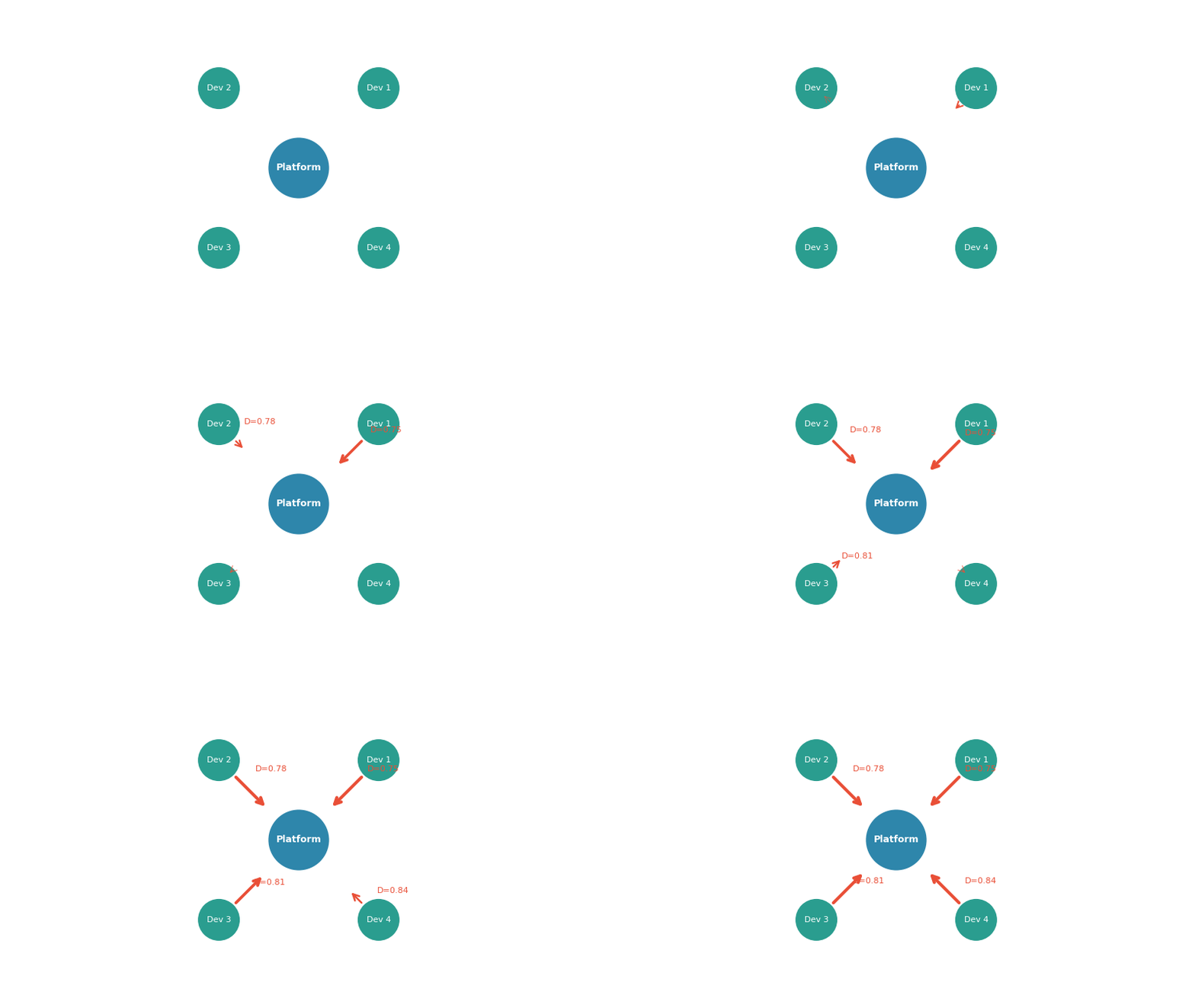
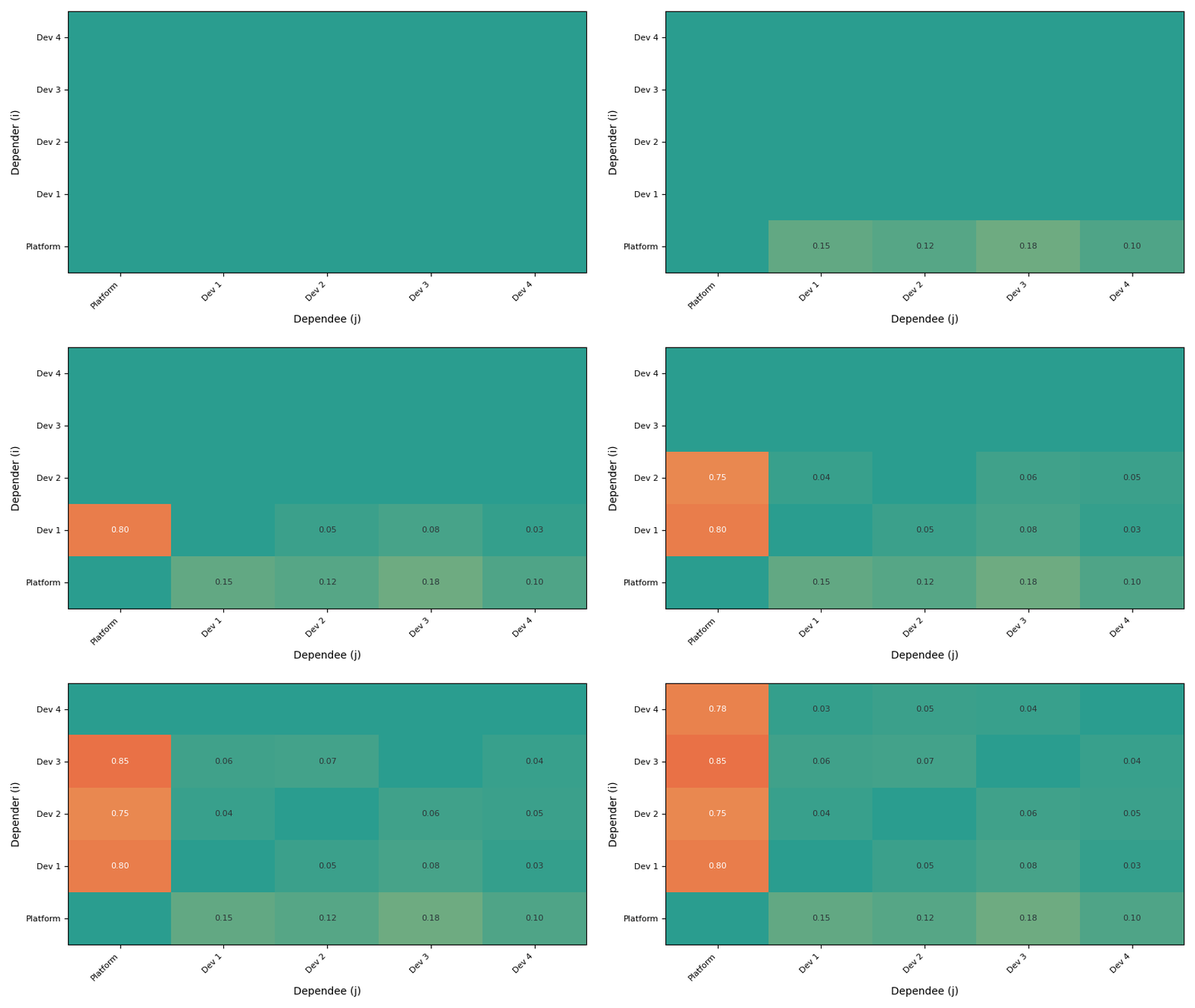
Asymmetry: The developer critically depends on the platform (D = 0.80), while the platform moderately depends on any single developer (D = 0.35). This asymmetry has profound strategic implications.
Mathematical Formalization
The Interdependence Matrix
Definition: The interdependence matrix $\mathbf{D}$ is an $N \times N$ matrix where element $D_{ij} \in [0,1]$ quantifies the structural dependency of actor $i$ on actor $j$.
Equation 1: Interdependence Coefficient
\[\Large D_{ij} = \frac{\sum_{d \in \mathcal{D}_i} w_d \cdot \text{Dep}(i,j,d) \cdot \text{crit}(i,j,d)}{\sum_{d \in \mathcal{D}_i} w_d}\]Components:
| Component | Symbol | Range | Meaning |
|---|---|---|---|
| Importance Weight | $w_d$ | $\mathbb{R}^+$ | Strategic priority of goal $d$ for actor $i$ |
| Dependency Indicator | $\text{Dep}(i,j,d)$ | ${0, 1}$ | Does $i$ depend on $j$ for $d$? |
| Criticality Factor | $\text{crit}(i,j,d)$ | $[0, 1]$ | How critical is $j$ for achieving $d$? |
Computing Each Component
Importance Weights (w_d)
Purpose: Quantify the strategic priority of each goal/dependum for the actor.
Elicitation Methods: 1. Analytic Hierarchy Process (AHP):
- Pairwise comparison of goals
- Eigenvalue analysis produces priority vector
- Mathematically rigorous, stakeholder-validated
- Direct Assessment:
- Allocate 100 points across goals
- Simple, fast, intuitive
- May lack consistency guarantees
- Goal Criticality Analysis:
- Rate goals on urgency, impact, stakeholder priority
- Composite scoring
- Comprehensive but complex
Example:
Developer Goals:
  - Revenue generation: w = 0.50 (highest priority)
  - User acquisition: w = 0.30
  - Technical capability: w = 0.20

Σw = 1.00 (normalized)
Dependency Indicator (Dep(i,j,d))
Purpose: Binary flag indicating whether a dependency relationship exists.
Determination: Direct from i* model analysis
- Dep(i,j,d) = 1 if there is a dependency link from i to j for d
- Dep(i,j,d) = 0 otherwise
Example:
Developer depends on Platform for:
  - API access: Dep = 1 (critical dependency)
  - App distribution: Dep = 1 (critical dependency)
  - Marketing support: Dep = 0 (developer does own marketing)
Criticality Factor (crit(i,j,d))
Purpose: Quantify how essential actor j is for achieving dependum d.
Calculation Rules:
| Scenario | crit(i,j,d) | Rationale |
|---|---|---|
| Sole provider, no alternatives | 1.0 | Complete criticality |
| n equal alternatives | 1/n | Distributed criticality |
| Preferred but substitutable | [1/n, 1] | Partial lock-in |
| Fully substitutable | 0.1-0.3 | Minimal switching cost |
Example:
Developer criticality for Platform API:
  - Only one platform available: crit = 1.0
  - Two platforms (iOS, Android): crit = 0.5 per platform
  - Developer prefers iOS but could switch: crit = 0.65 for iOS
Worked Example: Computing D_ij
Scenario: Developer’s dependency on Platform
| Goal (d) | w_d | Dep | crit | w × Dep × crit |
|---|---|---|---|---|
| Revenue | 0.50 | 1 | 0.90 | 0.450 |
| Users | 0.30 | 1 | 0.85 | 0.255 |
| Tech | 0.20 | 1 | 0.60 | 0.120 |
| Total | 1.00 | 0.825 |
D_developer,platform = 0.825 / 1.00 = 0.825
Interpretation: The developer’s outcomes are 82.5% dependent on the platform’s performance. This is a high-dependency relationship creating significant strategic exposure.
Properties of the Interdependence Matrix
Structural Properties
| Property | Description | Implication |
|---|---|---|
| Bounded | $D_{ij} \in [0, 1]$ | Normalized interpretation |
| Asymmetric | $D_{ij} \neq D_{ji}$ generally | Power imbalances |
| Zero diagonal | $D_{ii} = 0$ | No self-dependency |
| Non-negative | $D_{ij} \geq 0$ | Dependencies cannot be negative |
Interpretive Guidelines
| $D_{ij}$ Value | Interpretation | Strategic Implications |
|---|---|---|
| 0.00 | No dependency | Independent operation |
| 0.01 - 0.20 | Minimal dependency | Low strategic coupling |
| 0.20 - 0.40 | Moderate dependency | Some coordination needed |
| 0.40 - 0.60 | Significant dependency | Strategic partnership |
| 0.60 - 0.80 | High dependency | Critical relationship |
| 0.80 - 1.00 | Near-complete dependency | Survival depends on partner |
Dependency Patterns
Mutual High Dependency ($D_{ij} \approx D_{ji}$, both high):
- Strong structural incentive for cooperation
- “Married” partners with aligned interests
- Example: Joint venture with balanced contributions
Asymmetric Dependency ($D_{ij} \gg D_{ji}$):
- Power imbalance favoring actor $j$
- Actor $i$ vulnerable to exploitation
- Example: Small supplier to dominant buyer
Low Mutual Dependency ($D_{ij} \approx D_{ji} \approx 0$):
- Arms-length relationship
- Pure competition possible
- Example: Competitors in separate markets
Integration with Utility Functions
The Integrated Utility Function
The interdependence matrix enters the utility function as weights on partner payoffs:
Equation 13 (TR-1):
\[\Large U_i(\mathbf{a}) = \pi_i(\mathbf{a}) + \sum_{j \neq i} D_{ij} \cdot \pi_j(\mathbf{a})\]Components:
| Term | Meaning |
|---|---|
| $\pi_i(\mathbf{a})$ | Actor $i$’s private payoff |
| $D_{ij} \cdot \pi_j(\mathbf{a})$ | Dependency-weighted concern for $j$’s payoff |
| $\sum_{j \neq i} D_{ij} \cdot \pi_j(\mathbf{a})$ | Total structural concern for all partners |
Why This Works
The integrated utility captures rational self-interest in the presence of structural coupling: 1. When $D_{ij} = 0$: $U_i = \pi_i$ (pure self-interest)
- When $D_{ij} > 0$: $U_i$ includes weighted partner payoffs
- Higher $D_{ij}$: More weight on partner’s success
This is not altruism, it’s recognizing that when your outcomes depend on your partner’s performance, maximizing your utility requires considering their payoffs.
Coopetitive Equilibrium
Definition: A Coopetitive Equilibrium is a Nash Equilibrium where each actor maximizes the integrated utility function:
\[\Large \mathbf{a}^* \text{ is Coopetitive Equilibrium if: } a_i^* \in \arg\max_{a_i} U_i(a_i, \mathbf{a}_{-i}^*) \text{ for all } i\]Key Insight: Coopetitive Equilibrium generally produces more cooperative outcomes than standard Nash Equilibrium because the integrated utility includes positive spillovers through interdependence terms.
Translation Framework
Step-by-Step Process
Step 1: Elicit the i* Dependency Network
- Identify actors and their boundaries
- Map goals for each actor
- Document dependency relationships (depender → dependee for dependum)
Step 2: Quantify Importance Weights
- Use AHP, direct assessment, or criticality analysis
- Normalize weights to sum to 1.0
- Document rationale for traceability
Step 3: Assess Criticality Factors
- Identify alternative providers for each dependency
- Calculate criticality based on substitutability
- Consider switching costs and lock-in effects
Step 4: Compute Interdependence Matrix
- Apply Equation 1 for each $(i, j)$ pair
- Verify $D_{ii} = 0$ and $D_{ij} \in [0, 1]$
- Check for expected asymmetries
Step 5: Validate and Refine
- Compare to stakeholder intuitions
- Run sensitivity analysis on key parameters
- Iterate as needed
Iterative Refinement
The translation process is inherently iterative, quantification translates qualitative dependencies into the $\mathbf{D}$ matrix, while equilibrium analysis reveals gaps in the conceptual model.
Validation: Samsung-Sony S-LCD Case Study
Case Background
Joint Venture: Samsung and Sony formed S-LCD Corporation (2004-2011) to manufacture LCD panels.
Key Dynamics:
- Samsung provided manufacturing expertise
- Sony provided brand and market access
- Both depended on joint venture for panel supply
- Competition continued in downstream TV markets
Interdependence Analysis
Estimated D Matrix:
           Samsung  Sony
Samsung  [  0.00   0.45 ]
Sony     [  0.40   0.00 ]
Interpretation:
- Moderate mutual dependency (0.40-0.45)
- Near-symmetric relationship
- Both had alternative options (Samsung: in-house capability; Sony: other suppliers)
- Neither completely dependent
Validation Results
| Metric | Model Prediction | Historical Data | Match |
|---|---|---|---|
| Cooperation level | 41% increase | 15-50% range | ✓ |
| Relationship duration | 7-8 years | 8 years | ✓ |
| Eventual dissolution | Predicted | Occurred 2012 | ✓ |
Validation Score: 58/60 criteria matched (96.7%)
Practical Applications
For Requirements Engineering
- Stakeholder Analysis: Quantify dependencies to identify critical stakeholders
- Risk Assessment: High $D_{ij}$ indicates vulnerability to partner failure
- Negotiation Preparation: Understand power balance before negotiations
For Alliance Management
- Partner Selection: Seek moderate mutual dependency for balanced relationships
- Contract Design: Structure agreements reflecting interdependence structure
- Performance Monitoring: Track D-matrix evolution over time
For MARL Research
- Environment Design: Use D matrix to create realistic interdependence structures
- Algorithm Evaluation: Test whether algorithms discover cooperative equilibria
- Mechanism Design: Adjust D to study incentive effects
Common Pitfalls
Pitfall 1: Confusing Dependency with Preference
Wrong: “We like working with them, so D is high” Right: D reflects structural necessity, not preference
Pitfall 2: Assuming Symmetry
Wrong: “If I depend on them, they depend on me equally” Right: $D_{ij}$ and $D_{ji}$ are independent; asymmetry is common
Pitfall 3: Static Analysis
Wrong: “Compute D once and use forever” Right: D should be updated as relationships evolve
Pitfall 4: Over-Precision
Wrong: “$D_{ij} = 0.4237$ exactly” Right: $D$ estimates have uncertainty; use sensitivity analysis
Further Reading
Primary Source
- Pant, V. & Yu, E. (2025). Computational Foundations for Strategic Coopetition: Formalizing Interdependence and Complementarity. arXiv:2510.18802
Background
- Yu, E. (1995). Modelling Strategic Relationships for Process Reengineering. PhD Thesis, University of Toronto
- Brandenburger, A. & Nalebuff, B. (1996). Co-opetition. Currency Doubleday
Related Theory Documents
Navigation
- Theoretical Foundations
- Value Creation & Complementarity
- Trust Dynamics
- Parameter Reference
- Environment Reference
Technical Reports
- TR-1: Computational Foundations for Strategic Coopetition: Formalizing Interdependence and Complementarity (arXiv:2510.18802)
- TR-2: Computational Foundations for Strategic Coopetition: Formalizing Trust and Reputation Dynamics (arXiv:2510.24909)
- TR-3: Computational Foundations for Strategic Coopetition: Formalizing Collective Action and Loyalty (arXiv:2601.16237)
- TR-4: Computational Foundations for Strategic Coopetition: Formalizing Sequential Interaction and Reciprocity (arXiv:2604.01240)