Trust Dynamics
Formalizing Trust and Reputation Evolution in Strategic Coopetition (TR-2)
This document provides a comprehensive treatment of trust dynamics from Technical Report 2 (TR-2025-02), explaining how trust evolves through repeated interactions and how it affects strategic behavior.
Executive Summary
For Practitioners: Trust is not static, it evolves based on observed behavior. A single betrayal can destroy years of trust-building, but consistent cooperation slowly rebuilds confidence. Understanding these dynamics is essential for managing long-term partnerships.
For Researchers: We formalize trust as a two-layer dynamic system: immediate trust (T) responds to current behavior while reputation damage (R) tracks violation history. Asymmetric updating (3:1 negativity bias) and trust ceiling mechanisms create path-dependent dynamics validated against the Renault-Nissan Alliance.
Conceptual Foundation
Why Trust Matters in Coopetition
In coopetitive relationships, actors face ongoing temptation to defect, to capture short-term gains at the partner’s expense. Trust addresses this by: 1. Enabling Cooperation: High trust reduces perceived exploitation risk
- Gating Information Sharing: Actors share more with trusted partners
- Supporting Long-Horizon Planning: Trust enables commitment to joint investments
- Creating Relationship Value: Trusted partnerships are more productive
The Trust Evolution Challenge
Trust is inherently dynamic:
- Builds slowly through consistent cooperative behavior
- Erodes quickly through violations or perceived betrayals
- Creates path dependence: History constrains future possibilities
- Exhibits hysteresis: Damaged relationships cannot fully recover
Classical game theory lacks mechanisms for this dynamic evolution. Our formalization addresses this gap.
Distinguishing Trust Concepts
| Concept | Definition | Our Formalization |
|---|---|---|
| Immediate Trust | Current confidence in partner | $T_{ij} \in [0, 1]$ |
| Reputation | Historical track record | $R_{ij} \in [0, 1]$ (damage) |
| Trustworthiness | Actual reliability | Not modeled (observable only through signals) |
| Trust Ceiling | Maximum achievable trust | $\Theta = 1 - R$ |
Two-Layer Trust Architecture
Layer 1: Immediate Trust ($T_{ij}$)
Definition: Actor $i$’s current confidence in actor $j$’s reliability and cooperative intent.
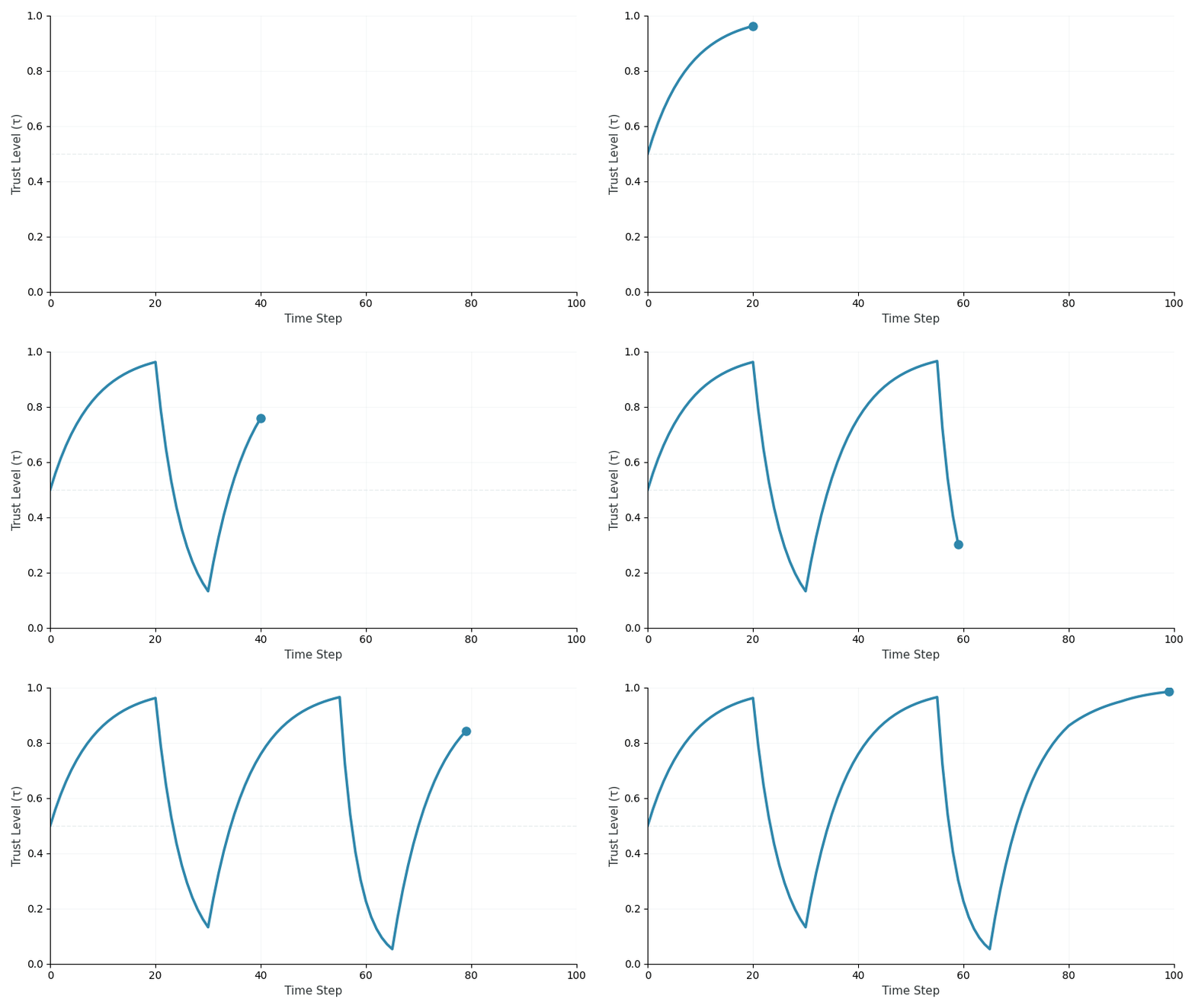
Properties:
- Range: $T_{ij} \in [0, 1]$
- Responsive to recent behavior
- Can increase (trust building) or decrease (trust erosion)
- Constrained by trust ceiling $\Theta$
Interpretation:
| T Value | Interpretation | Behavioral Implication |
|---|---|---|
| 0.0 - 0.2 | No trust | Expect defection; protect self |
| 0.2 - 0.4 | Low trust | Cautious engagement; verify behavior |
| 0.4 - 0.6 | Moderate trust | Willing to cooperate with monitoring |
| 0.6 - 0.8 | High trust | Confident cooperation; share information |
| 0.8 - 1.0 | Full trust | Deep partnership; strategic alignment |
Layer 2: Reputation Damage ($R_{ij}$)
Definition: Accumulated history of actor $j$’s violations from actor $i$’s perspective.
Properties:
- Range: $R_{ij} \in [0, 1]$ where 0 = pristine, 1 = completely damaged
- Accumulates through violations
- Decays slowly over time (forgetting)
- Creates permanent limits on trust recovery
Interpretation:
| R Value | Interpretation | Trust Ceiling (Θ) |
|---|---|---|
| 0.00 | No violation history | 1.00 (full recovery possible) |
| 0.20 | Minor past issues | 0.80 |
| 0.40 | Significant violations | 0.60 |
| 0.60 | Severe damage | 0.40 |
| 0.80 | Major betrayals | 0.20 |
| 1.00 | Complete destruction | 0.00 (trust impossible) |
The Trust Ceiling Mechanism
Equation 7 (TR-2):
\[\Large \Theta_{ij}^t = 1 - R_{ij}^t\]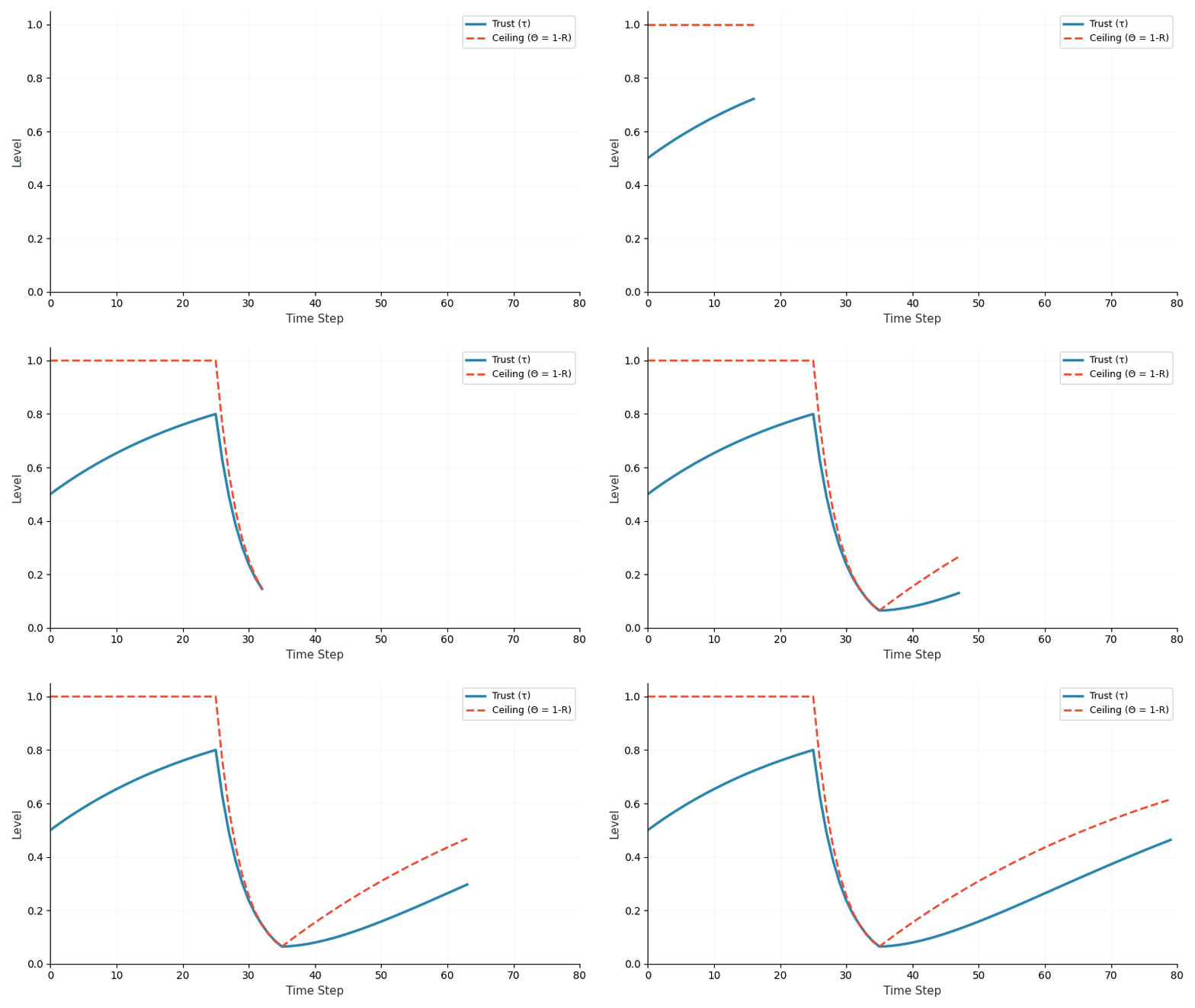
The trust ceiling creates hysteresis: even perfect cooperation cannot restore trust beyond this limit.
Example Trajectory:
Initial state: T=0.50, R=0.00, Θ=1.00
After violation: T=0.30, R=0.40, Θ=0.60
After 10 periods cooperation: T→0.58 (cannot exceed 0.60)
After 50 periods cooperation: T→0.60 max (ceiling reached)
The relationship can improve but will always bear the scar of past violations.
Cooperation Signal
Assessing Partner Behavior
To update trust, actors assess whether partners are cooperating or defecting. This requires comparing observed behavior to expectations.
Equation 4 (TR-2): Cooperation Signal
\[\Large s_{ij}^t = \tanh\left(\kappa \cdot (a_j^t - a_j^{\text{baseline}})\right)\]Components:
| Component | Meaning | Typical Value |
|---|---|---|
| $a_j$ | Actor $j$’s actual action | Observed cooperation level |
| $a_j^{\text{baseline}}$ | Expected cooperation | Context-dependent norm |
| $\kappa$ | Signal sensitivity | 1.0 (default) |
| $s_{ij}$ | Cooperation signal | $\in (-1, 1)$ |
Signal Interpretation
| s Value | Interpretation | Trust Effect |
|---|---|---|
| s > 0.5 | Strong positive signal | Rapid trust building |
| 0 < s < 0.5 | Mild cooperation | Gradual trust building |
| s ≈ 0 | Met expectations | Neutral (slight positive) |
| -0.5 < s < 0 | Mild defection | Gradual trust erosion |
| s < -0.5 | Strong violation | Rapid trust erosion |
Why Bounded (tanh)?
The hyperbolic tangent function ensures:
- Bounded signals: Even extreme deviations produce finite trust changes
- Smooth transitions: No discontinuities in trust dynamics
- Diminishing sensitivity: Very large deviations don’t dominate
Baseline Elicitation
The baseline $a_j^{\text{baseline}}$ is context-specific:
| Context | Baseline Determination |
|---|---|
| Contractual | Agreed-upon cooperation levels |
| Historical | Moving average of past behavior |
| Normative | Industry/organizational standards |
| Rational | Nash equilibrium prediction |
Asymmetric Trust Evolution
The Negativity Bias
Trust evolution is fundamentally asymmetric: violations hurt more than cooperation helps.
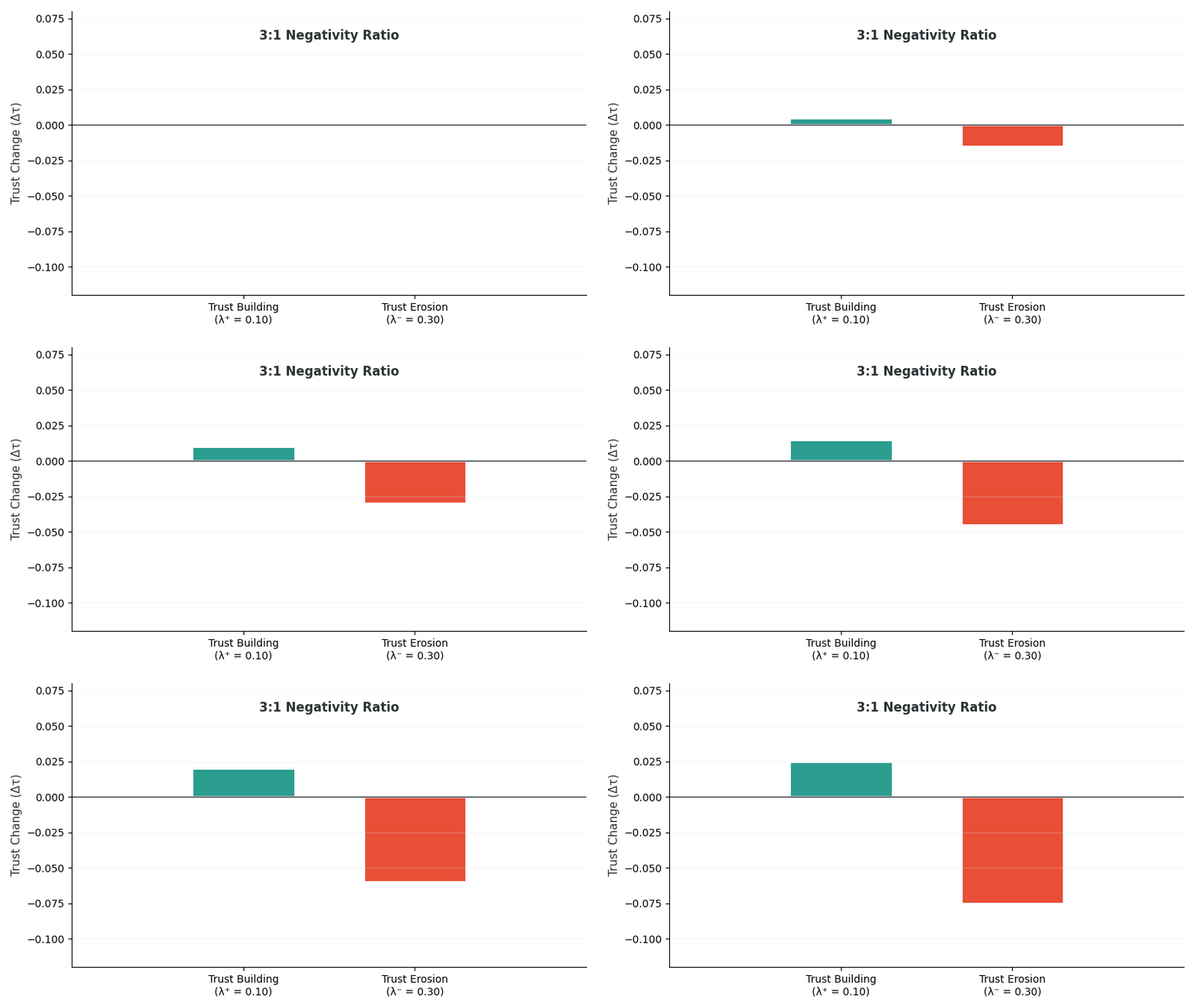
Equation 5 (TR-2): Trust Change
\[\Delta T_{ij}^t = \begin{cases} \lambda^+ \cdot s_{ij}^t \cdot (\Theta_{ij}^t - T_{ij}^t) & \text{if } s_{ij}^t > 0 \text{ (building)} \\ -\lambda^- \cdot |s_{ij}^t| \cdot T_{ij}^t \cdot (1 + \xi \cdot D_{ij}) & \text{if } s_{ij}^t \leq 0 \text{ (erosion)} \end{cases}\]Trust Building ($s > 0$)
\[\Large \Delta T = \lambda^+ \cdot s \cdot (\Theta - T)\]Components:
- $\lambda^+ = 0.10$ (validated building rate)
- $s$: Positive cooperation signal
- $(\Theta - T)$: Available space below ceiling
Properties:
- Building slows as trust approaches ceiling
- Cannot exceed ceiling (Θ)
- Positive feedback: cooperation → trust → more cooperation
Trust Erosion ($s \leq 0$)
\[\Large \Delta T = -\lambda^- \cdot |s| \cdot T \cdot (1 + \xi \cdot D_{ij})\]Components:
- $\lambda^- = 0.30$ (validated erosion rate)
-
$ s $: Magnitude of violation signal - $T$: Current trust level (more to lose when trust is high)
- $(1 + \xi \cdot D_{ij})$: Interdependence amplification
Properties:
- Erosion is faster than building (λ⁻ > λ⁺)
- High-trust relationships fall harder (proportional to T)
- High-dependency relationships hurt more (amplification)
The 3:1 Ratio
Validated Finding: Trust erodes approximately 3× faster than it builds.
\[\Large \text{Negativity Ratio} = \frac{\lambda^-}{\lambda^+} = \frac{0.30}{0.10} = 3.0\]Empirical Grounding: This ratio aligns with behavioral economics research on negativity bias (Rozin & Royzman, 2001; Slovic, 1993):
- Negative events are weighted more heavily in judgment
- Trust is evolutionarily costly to give (vulnerability)
- Violations signal potential future harm
Interdependence Amplification
Equation Component: $(1 + \xi \cdot D_{ij})$
When actor $i$ depends heavily on actor $j$ (high $D_{ij}$), violations by $j$ cause amplified trust damage:
\[\Large \text{Amplification factor} = 1 + \xi \cdot D_{ij}\]| Dependency Level | $D_{ij}$ | Amplification Factor |
|---|---|---|
| Low dependency | 0.2 | 1.10 |
| High dependency | 0.8 | 1.40 |
Intuition: Betrayal by someone you depend on hurts more because:
- Direct goal impact (structural coupling)
- Limited alternatives (can’t easily switch)
- Psychological salience (greater attention to critical dependencies)
Benchmark Evidence: High-dependency relationships experience 27% faster trust erosion for equivalent violations.
Reputation Dynamics
Reputation Damage Accumulation
Equation 8 (TR-2): Reputation Change
\[\Large R_{ij}^{t+1} = R_{ij}^t + \Delta R_{ij}^t - \delta_R \cdot R_{ij}^t\]Damage Term:
\[\Delta R_{ij}^t = \begin{cases} \mu_R \cdot |s_{ij}^t| \cdot (1 - R_{ij}^t) & \text{if } s_{ij}^t < 0 \text{ (violation)} \\ 0 & \text{if } s_{ij}^t \geq 0 \text{ (no damage)} \end{cases}\]Parameters
| Parameter | Symbol | Validated Value | Meaning |
|---|---|---|---|
| Damage Severity | $\mu_R$ | 0.60 | How much damage per violation |
| Decay Rate | $\delta_R$ | 0.03 | Forgetting rate per period |
Damage Mechanics
-
$\mu_R \cdot s $: Proportional to violation severity - $(1 - R)$: Available damage space (cannot exceed 1.0)
- $\delta_R \cdot R$: Gradual forgetting over time
Forgetting Dynamics
Reputation decays slowly even without new violations:
\[\Large R(t) = R_0 \cdot (1 - \delta_R)^t\]Time to decay from $R=0.50$ to $R=0.25$ (half-life):
- $0.25 = 0.50 \times 0.97^t$
- $t \approx 23$ periods
With $\delta_R = 0.03$, forgetting is slow, violations leave lasting marks.
Trust-Performance Relationship
Benchmark Validation
From 760 experiments across 20 algorithms:
Trust-Return Correlation: r = 0.552 (p < 0.001)
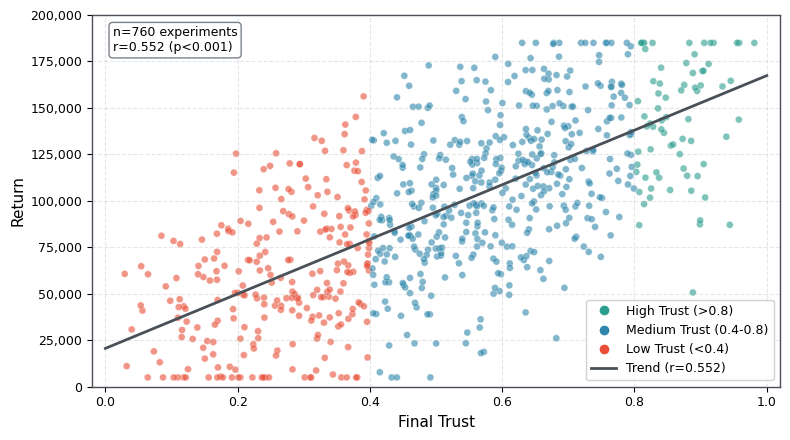
Algorithm Performance by Trust
| Trust Category | Algorithm Examples | Mean Return |
|---|---|---|
| High Trust (>0.8) | Constant_050, ISAC | 72,494 |
| Medium Trust (0.4-0.8) | MADDPG, VDN | 50,903 |
| Low Trust (<0.4) | IPPO, SelfPlay_PPO | 21,019 |
The Constant_050 vs Random Natural Experiment
| Metric | Random | Constant_050 | Insight |
|---|---|---|---|
| Mean Cooperation | 47.7% | 55.0% | +7.3% |
| Cooperation Variance | ~29% | 0% | -29% |
| Final Trust | 7.1% | 98.7% | +91.6% |
| Mean Return | 24,939 | 72,494 | +190% |
Critical Insight: Constant_050’s superior performance comes from consistency, not higher average cooperation. Unpredictable cooperation triggers negativity bias, eroding trust despite moderate average behavior.
Hysteresis and Path Dependence
What is Hysteresis?
Hysteresis means the system’s state depends on its history, not just current inputs. In trust:
- A relationship that was damaged cannot return to its original state
- The path to current trust level matters, not just the level itself
- Future possibilities are constrained by past violations
Formal Characterization
Trust Ceiling:
\[\Large \Theta(t) = 1 - R(t)\]For any trajectory with violations:
\[\Large \max[T(t \to \infty)] = \Theta < 1.0\]Even infinite cooperation cannot restore trust to pre-violation levels.
Recovery Dynamics
Validated Finding (TR-2 §7.3): Median recovery ratio = 1.11
After 35 periods of sustained cooperation following a violation:
- Trust reaches ~111% of pre-violation level
- BUT: Without violation, trust would have reached ~98%
- Net shortfall: ~9% permanent damage
Practical Implications
- Prevention over cure: Avoiding violations is more efficient than recovering
- Reputation management: Long-term reputation is a strategic asset
- Crisis planning: Recovery requires sustained effort over extended periods
- Relationship investment: High-trust relationships are valuable and fragile
Trust-Gated Reciprocity
Extending Utility Functions
Trust modulates cooperative behavior through utility augmentation:
Equation (TR-2): Trust-Gated Reciprocity
\[\Large U_i(\mathbf{a}, \mathbf{T}^t) = U_i^{\text{base}}(\mathbf{a}) + \sum_{j \neq i} \rho \cdot T_{ij}^t \cdot (a_j - a_j^{\text{baseline}}) \cdot a_i\]Components:
- $U_i^{\text{base}}$: Standard integrated utility from TR-1
- $\rho = 0.20$: Reciprocity strength
- $T_{ij}$: Trust level (gates reciprocity)
- $(a_j - a_j^{\text{baseline}})$: Partner’s cooperation signal
- $a_i$: Own cooperation (interaction)
Mechanism
When trust is high ($T_{ij} \to 1$):
- Reciprocity term is active
- Partner cooperation increases utility of own cooperation
- Creates positive feedback loop
When trust is low ($T_{ij} \to 0$):
- Reciprocity term vanishes
- Partner cooperation has no effect
- No coordination incentive
Strategic Implications
Trust gates cooperation even when mutual benefit is objectively available:
| Scenario | T Level | Cooperation? | Rationale |
|---|---|---|---|
| High T, partner cooperates | High | Yes | Reciprocity rewarded |
| High T, partner defects | High | Maybe | Still some trust |
| Low T, partner cooperates | Low | No | Don’t believe it will continue |
| Low T, partner defects | Low | No | Expect exploitation |
Validation: Renault-Nissan Alliance
Case Background
The Renault-Nissan Alliance (1999-present) provides a longitudinal test case with documented trust evolution across five phases:
| Phase | Period | Trust Dynamic |
|---|---|---|
| Crisis | 1999-2001 | Low trust, high stakes |
| Recovery | 2001-2005 | Trust building through results |
| Growth | 2005-2010 | Expanding cooperation |
| Ghosn Era | 2010-2018 | Centralized trust in leader |
| Post-Ghosn | 2018-2025 | Crisis and partial recovery |
Model Calibration
renault_nissan_params = {
    'n_agents': 2,
    'max_steps': 26,      # 26 years
    'lambda_plus': 0.08,  # Cross-cultural: slower building
    'lambda_minus': 0.32, # Standard erosion
    'mu_R': 0.65,         # Visible scandals: higher damage
    'delta_R': 0.02,      # Slower forgetting
    'T_init': 0.30,       # Started in crisis
    'R_init': 0.20,       # Some initial damage
}
Validation Results
Overall Score: 49/60 (81.7%)
| Phase | Predicted Pattern | Historical Match | Score |
|---|---|---|---|
| Crisis | Low trust, cautious cooperation | ✓ | 10/12 |
| Recovery | Gradual trust building | ✓ | 10/12 |
| Growth | High cooperation, trust peak | ✓ | 10/12 |
| Ghosn Era | Stable high trust | Partial | 9/12 |
| Post-Ghosn | Sharp decline, partial recovery | ✓ | 10/12 |
Key Dynamics Captured
- Crisis Response: Low initial trust matched historical caution
- Recovery Path: Gradual trust building through consistent results
- Ghosn Scandal Impact: Sharp trust erosion matching documented crisis
- Hysteresis: Post-recovery trust ceiling below pre-scandal levels
Implementation Details
Code Correspondence
Trust dynamics are implemented in coopetition_gym/core/trust_dynamics.py:
def compute_cooperation_signal(action, baseline, kappa=1.0):
    """Equation 4: Bounded cooperation signal."""
    return np.tanh(kappa * (action - baseline))

def update_trust(T, signal, ceiling, lambda_plus, lambda_minus,
                 xi, D_ij):
    """Equation 5: Asymmetric trust evolution."""
    if signal > 0:
        # Trust building
        delta_T = lambda_plus * signal * (ceiling - T)
    else:
        # Trust erosion with interdependence amplification
        delta_T = -lambda_minus * abs(signal) * T * (1 + xi * D_ij)
    return np.clip(T + delta_T, 0.0, 1.0)

def update_reputation(R, signal, mu_R, delta_R):
    """Equation 8: Reputation damage evolution."""
    if signal < 0: delta_R_damage = mu_R * abs(signal) * (1 - R)
    else: delta_R_damage = 0.0
    decay = delta_R * R
    return np.clip(R + delta_R_damage - decay, 0.0, 1.0)

def compute_trust_ceiling(R):
    """Equation 7: Trust ceiling from reputation."""
    return 1.0 - R
Environment Integration
import coopetition_gym

# Create environment with custom trust parameters
env = coopetition_gym.make("TrustDilemma-v0",
    lambda_plus=0.10,
    lambda_minus=0.30,
    mu_R=0.60,
    delta_R=0.03,
    xi=0.50,
    kappa=1.0,
    T_init=0.50,
    R_init=0.00,
)

# Access trust state
obs, info = env.reset()
trust_matrix = info['trust_matrix']
reputation_matrix = info['reputation_matrix']
Practical Applications
For Partnership Management
- Monitor trust trajectory: Track T over time for early warning
- Prevent violations: Small violations have outsized impact
- Plan for recovery: Budget extended cooperation after incidents
- Manage reputation: R damage is persistent; protect reputation
For Algorithm Design
- Consistency over magnitude: Predictable cooperation builds trust
- Avoid defection spirals: Single defection can be catastrophic
- Long horizon: Trust benefits compound over time
- Trust as state: Include trust in policy state representation
For Environment Customization
# Post-crisis scenario
crisis_env = coopetition_gym.make("TrustDilemma-v0",
    T_init=0.20,   # Low starting trust
    R_init=0.50,   # Significant reputation damage
)

# High-trust scenario
trusted_env = coopetition_gym.make("TrustDilemma-v0",
    T_init=0.80,   # High starting trust
    R_init=0.00,   # No reputation damage
)
Further Reading
Primary Source
- Pant, V. & Yu, E. (2025). Computational Foundations for Strategic Coopetition: Formalizing Trust and Reputation Dynamics. arXiv:2510.24909
Background
- Mayer, R., Davis, J., & Schoorman, F. (1995). An Integrative Model of Organizational Trust. Academy of Management Review
- Slovic, P. (1993). Perceived Risk, Trust, and Democracy. Risk Analysis
- Rozin, P. & Royzman, E. (2001). Negativity Bias, Negativity Dominance, and Contagion. PSPR
Related Theory Documents
Benchmark Analysis
Navigation
- Theoretical Foundations
- Interdependence Framework
- Value Creation & Complementarity
- Parameter Reference
- Environment Reference
Technical Reports
- TR-1: Computational Foundations for Strategic Coopetition: Formalizing Interdependence and Complementarity (arXiv:2510.18802)
- TR-2: Computational Foundations for Strategic Coopetition: Formalizing Trust and Reputation Dynamics (arXiv:2510.24909)
- TR-3: Computational Foundations for Strategic Coopetition: Formalizing Collective Action and Loyalty (arXiv:2601.16237)
- TR-4: Computational Foundations for Strategic Coopetition: Formalizing Sequential Interaction and Reciprocity (arXiv:2604.01240)