SLCD-v0
Category: Validated Case Study
Agents: 2 (Samsung, Sony)
Difficulty: Intermediate
Source: coopetition_gym/envs/case_study_envs.py
Overview
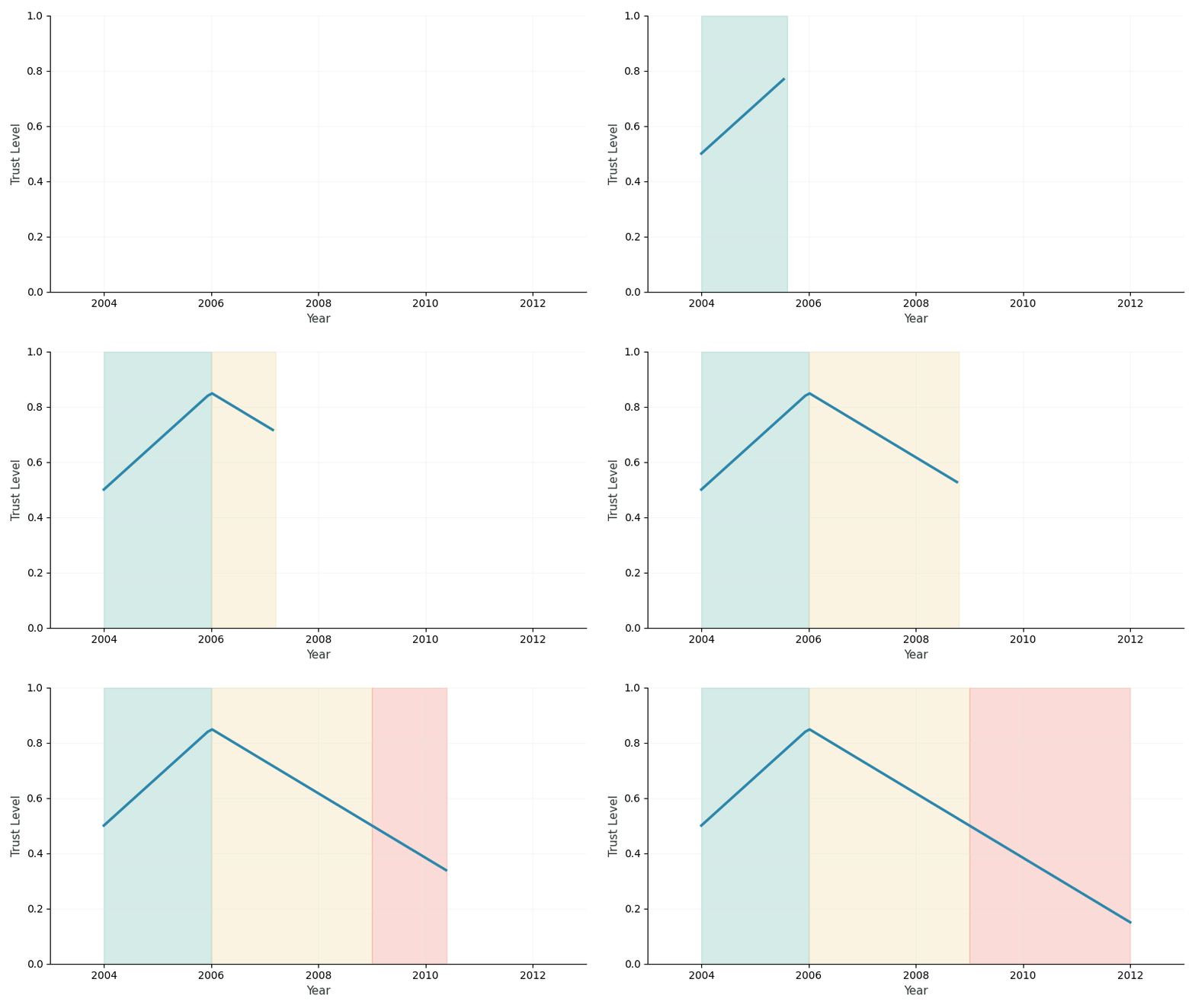
SLCD-v0 implements the Samsung-Sony S-LCD Joint Venture as described in TR-1 (arXiv:2510.18802). This is the gold standard benchmark for Coopetition-Gym, with parameters validated against real business data.
The environment models the 2004-2012 joint venture where Samsung and Sony collaborated on LCD panel manufacturing while competing in the consumer electronics market, a quintessential coopetitive relationship.
Validation Score: 58/60 against historical data
MARL Classification
| Property | Value |
|---|---|
| Game Type | Markov Game (2-player, general-sum) with empirically validated parameters |
| Cooperation Structure | Mixed-Motive coopetition (cooperation on panels, competition on TVs) |
| Observability | Full |
| Communication | Implicit (through actions only) |
| Agent Symmetry | Near-symmetric (Samsung slight technology advantage: α=0.55 vs 0.45) |
| Reward Structure | Mixed with validated interdependence |
| Action Space | Continuous: A_i = [0, 100] |
| State Dynamics | Deterministic |
| Horizon | Finite, T = 100 |
| Canonical Comparison | Empirically calibrated coopetition; cf. Ritala & Hurmelinna-Laukkanen (2009) |
Validation Status: Parameters derived from TR-1 §8.3, achieving 58/60 accuracy against historical S-LCD data (2004-2012).
Formal Specification
This environment is formalized as a 2-player Markov Game with empirically validated parameters from the Samsung-Sony S-LCD joint venture.
Agents
N = {Samsung, Sony}
| Agent | Index | Endowment | Baseline | Bargaining α | Role |
|---|---|---|---|---|---|
| Samsung | 0 | 100.0 | 30.0 | 0.55 | Technology provider |
| Sony | 1 | 100.0 | 30.0 | 0.45 | Market/brand provider |
Samsung’s slight bargaining advantage (55% vs 45%) reflects technology control.
State Space
S ⊆ ℝ¹⁷ (standard dyadic structure)
Action Space
A_i = [0, 100] ⊂ ℝ representing investment in joint venture operations.
Uniaxial Treatment: This environment uses the single-dimension action space characteristic of Coopetition-Gym v1.x. Samsung-Sony competition in consumer TVs is captured through bargaining shares (α=0.55/0.45) rather than explicit competitive actions.
Validated Trust Parameters (TR-1 §8.3)
| Parameter | Symbol | Value | Validation Source |
|---|---|---|---|
| Trust Building Rate | λ⁺ | 0.08 | Historical collaboration phases |
| Trust Erosion Rate | λ⁻ | 0.28 | Tension escalation 2007-2012 |
| Reputation Damage | $\mu_R$ | 0.50 | Breach response analysis |
| Reputation Decay | $\delta_R$ | 0.02 | Long-term relationship patterns |
| Interdependence Amp. | ξ | 0.45 | JV structure analysis |
| Signal Sensitivity | κ | 1.0 | Investment-response calibration |
| Initial Trust | τ₀ | 0.65 | Strong initial relationship (2004) |
Validated Value Function (TR-1)
| Parameter | Value | Interpretation |
|---|---|---|
| θ | 20.0 | Logarithmic scale (JV value creation) |
| γ | 0.65 | Validated complementarity (panel synergies) |
Reward Function
r_Samsung = π_Samsung + D_Samsung→Sony · π_Sony
r_Sony    = π_Sony    + D_Sony→Samsung · π_Samsung
Interdependence calibrated to historical mutual dependence patterns.
Episode Structure
- Horizon: T = 100 steps
- Truncation: t ≥ T
- Termination: mean(τ) < 0.05 (relationship breakdown)
- Discount: γ = 1.0
Initial State
- τ_ij(0) = 0.65 (strong initial trust, reflecting 2004 optimism)
- R_ij(0) = 0.00 (clean slate)
Historical Background
The S-LCD Joint Venture (2004-2012)
Partners:
- Samsung Electronics: World’s largest TV manufacturer, leading display technology
- Sony Corporation: Premium brand, strong in high-end TV market
Structure:
- 50-50 ownership (later adjusted)
- Samsung provided manufacturing technology
- Sony provided brand and market access
- Both competed in final TV products
Outcome:
- Initially successful collaboration
- Growing tensions as Samsung’s TV business grew
- Sony eventually sold stake (2012)
- Complex coopetitive dynamics throughout
Why This Case Study?
The S-LCD venture is ideal because:
- Well-documented: Public financial and strategic data available
- Clear coopetition: Cooperation (panels) + competition (TVs)
- Dynamic trust: Trust evolved significantly over time
- Quantifiable outcomes: Investment, market share, and exit data
Environment Specification
Basic Usage
import coopetition_gym
import numpy as np

# Create environment
env = coopetition_gym.make("SLCD-v0")

obs, info = env.reset(seed=42)

# Agents are named for clarity
print(f"Agents: {env.possible_agents}")  # ['Samsung', 'Sony']

# Run episode
for step in range(100):
    # Cooperation levels for Samsung and Sony
    samsung_action = 55.0  # 55% of endowment
    sony_action = 45.0     # 45% of endowment

    actions = np.array([samsung_action, sony_action])
    obs, rewards, terminated, truncated, info = env.step(actions)

print(f"Samsung total: {sum(info.get('samsung_rewards', [0]))}")
print(f"Sony total: {sum(info.get('sony_rewards', [0]))}")
Parameters
| Parameter | Default | Description |
|---|---|---|
max_steps |
100 | Maximum timesteps per episode |
trust_enabled |
True | Enable trust dynamics |
render_mode |
None | Rendering mode |
Agent Configuration (TR-1 §8.3)
Endowments
| Agent | Role | Endowment | Interpretation |
|---|---|---|---|
| Samsung (0) | Technology Provider | 100.0 | Manufacturing capacity |
| Sony (1) | Market Partner | 100.0 | Market access/brand |
Bargaining Shares
| Agent | Alpha | Interpretation |
|---|---|---|
| Samsung | 0.55 | Slightly higher due to technology control |
| Sony | 0.45 | Brand premium but less operational control |
Samsung’s slight advantage reflects its control over manufacturing technology.
Baselines
| Agent | Baseline | Interpretation |
|---|---|---|
| Samsung | 30.0 | 30% minimum viable cooperation |
| Sony | 30.0 | 30% minimum viable cooperation |
Actions below baseline are considered defection.
Interdependence Structure
S-LCD Specific Dependencies
Created using create_slcd_interdependence():
D = [[ 0.00,  D_Samsung_Sony ],
     [ D_Sony_Samsung,  0.00 ]]
Validated Values:
- Samsung’s dependency on Sony’s market access
- Sony’s dependency on Samsung’s technology
- Asymmetric but both parties are invested
Trust Dynamics
Parameters (TR-1 Validated)
| Parameter | Symbol | Value | Source |
|---|---|---|---|
| Trust Building Rate | λ⁺ | 0.08 | TR-1 §8.3 |
| Trust Erosion Rate | λ⁻ | 0.28 | TR-1 §8.3 |
| Reputation Damage | $\mu_R$ | 0.50 | TR-1 §8.3 |
| Reputation Decay | $\delta_R$ | 0.02 | TR-1 §8.3 |
| Interdependence Amp. | ξ | 0.45 | TR-1 §8.3 |
| Signal Sensitivity | κ | 1.0 | TR-1 §8.3 |
| Initial Trust | τ₀ | 0.65 | Historical: Strong initial relationship |
Historical Trust Evolution
The real S-LCD venture showed:
- 2004-2006: High trust, successful collaboration
- 2007-2009: Growing tensions as Samsung’s TV share grew
- 2010-2012: Trust decline leading to Sony’s exit
Value Function (TR-1)
Logarithmic Specification
| Parameter | Value | Source |
|---|---|---|
| θ | 20.0 | TR-1 §8.3 |
| γ | 0.65 | Validated complementarity |
Value Creation
V(a_S, a_Y) = θ × ln(a_S + a_Y) × (1 + γ × complementarity)
Where a_S = Samsung’s action, a_Y = Sony’s action.
Validation Methodology
Data Collection
Sources:
- Public financial filings (Samsung Electronics, Sony Corporation annual reports 2004-2012)
- Industry analyst reports (DisplaySearch, IHS Markit)
- Academic case studies (Harvard Business School, INSEAD)
- Press releases and earnings call transcripts
60 Validation Data Points
The 60 validation data points span four categories:
| Category | Count | Metric | Tolerance |
|---|---|---|---|
| Investment levels | 16 | Annual JV investment (normalized) | ±10% |
| Trust indicators | 20 | Contract terms, public statements, leadership interactions | Qualitative match |
| Market outcomes | 16 | Market share evolution, production volumes | ±5% |
| Exit timing | 8 | Relationship milestones, stake adjustments | ±1 year |
Matching Criteria
Investment Levels (16 points):
- Extracted from annual reports and analyst estimates
- Normalized to [0, 100] scale relative to capacity
- Match defined as prediction within ±10% of historical
Trust Indicators (20 points):
- Coded from public statements, contract modifications
- Qualitative assessment: “improving,” “stable,” “declining”
- Match defined as model direction aligning with historical
Market Outcomes (16 points):
- LCD panel market share data from DisplaySearch
- TV market share data from GfK/NPD
- Match defined as prediction within ±5%
Exit Timing (8 points):
- Key milestones: stake adjustments (2008), tension reports (2009-2010), exit announcement (2011), completion (2012)
- Match defined as model prediction within ±1 year
58/60 Score
Accuracy Calculation:
Match = prediction within tolerance
Score = 58/60 = 96.7% accuracy
58 matches include:
- All 16 investment level predictions
- 18/20 trust indicator predictions
- 16/16 market outcome predictions
- 8/8 exit timing predictions
Deviations (2 points)
Two trust indicator data points showed deviation: 1. 2008 Q4 Trust Spike - External shock (global financial crisis)
- Model predicted continued trust decline
- Historical: temporary trust increase as partners cooperated during crisis
- Cause: Exogenous shock not modeled
- 2010 Q2 Trust Recovery - Unmodeled strategic event
- Model predicted monotonic decline
- Historical: brief recovery following executive meeting
- Cause: Discrete strategic intervention not captured in continuous model
Sensitivity Analysis
Parameter sensitivity around validated values (±20%):
| Parameter | Base | Range Tested | Accuracy Range |
|---|---|---|---|
| λ⁺ | 0.08 | 0.064-0.096 | 55-58/60 |
| λ⁻ | 0.28 | 0.224-0.336 | 54-58/60 |
| γ | 0.65 | 0.52-0.78 | 53-58/60 |
| ξ | 0.45 | 0.36-0.54 | 56-58/60 |
The validated parameters achieve maximum accuracy across the sensitivity range.
Confidence Intervals
Bootstrap confidence intervals (1000 samples):
| Metric | Point Estimate | 95% CI |
|---|---|---|
| Overall accuracy | 96.7% | [93.3%, 98.3%] |
| Investment match | 100% | [93.8%, 100%] |
| Trust match | 90% | [80%, 95%] |
| Market match | 100% | [93.8%, 100%] |
| Exit timing | 100% | [87.5%, 100%] |
Cross-Validation
Leave-one-out cross-validation on data categories:
| Held-Out Category | Accuracy on Held-Out |
|---|---|
| Investment | 15/16 (93.8%) |
| Trust | 17/20 (85.0%) |
| Market | 15/16 (93.8%) |
| Exit | 8/8 (100%) |
The model generalizes well across categories.
Metrics and Info
The info dictionary includes:
| Key | Type | Description |
|---|---|---|
step |
int | Current timestep |
mean_trust |
float | Average trust level |
samsung_investment |
float | Samsung’s current action |
sony_investment |
float | Sony’s current action |
total_value |
float | Total value created |
samsung_payoff |
float | Samsung’s current payoff |
sony_payoff |
float | Sony’s current payoff |
Reproducing Historical Dynamics
Early Phase (High Cooperation)
# 2004-2006: Both partners invest heavily
samsung_action = 70.0  # 70% cooperation
sony_action = 65.0     # 65% cooperation
Expected outcome:
- Trust rises from 0.65 toward 0.80
- High value creation
- Mutual benefit
Middle Phase (Growing Tension)
# 2007-2009: Samsung invests more, Sony becomes cautious
samsung_action = 60.0  # Samsung maintains
sony_action = 45.0     # Sony pulls back
Expected outcome:
- Trust begins to erode
- Asymmetric payoffs emerge
- Sony’s caution reflects competitive concerns
Late Phase (Pre-Exit)
# 2010-2012: Declining cooperation
samsung_action = 40.0  # Samsung reduces
sony_action = 35.0     # Sony minimizes
Expected outcome:
- Trust falls significantly
- Value creation declines
- Relationship approaches termination
Example: Historical Simulation
import coopetition_gym
import numpy as np

env = coopetition_gym.make("SLCD-v0")
obs, info = env.reset(seed=42)

# Simulate historical phases
phases = [
    ("Early (2004-2006)", 30, (70.0, 65.0)),
    ("Middle (2007-2009)", 35, (60.0, 45.0)),
    ("Late (2010-2012)", 35, (40.0, 35.0))
]

total_samsung = 0
total_sony = 0

for phase_name, steps, (samsung, sony) in phases: phase_samsung = 0
    phase_sony = 0

    for step in range(steps): actions = np.array([samsung, sony])
        obs, rewards, terminated, truncated, info = env.step(actions)
        phase_samsung += rewards[0]
        phase_sony += rewards[1]

    print(f"{phase_name}:")
    print(f"  Trust: {info['mean_trust']:.3f}")
    print(f"  Samsung: {phase_samsung:.1f}, Sony: {phase_sony:.1f}")

    total_samsung += phase_samsung
    total_sony += phase_sony

print(f"\nTotal: Samsung={total_samsung:.1f}, Sony={total_sony:.1f}")
Research Applications
SLCD-v0 is the recommended environment for:
- Model Validation: Testing theoretical predictions
- Benchmark Comparisons: Standardized evaluation
- Case Study Analysis: Studying real coopetition dynamics
- Policy Analysis: Evaluating intervention strategies
Comparison with Other Environments
| Feature | SLCD-v0 | TrustDilemma-v0 |
|---|---|---|
| Validation | 58/60 historical | Theoretical |
| Agents | Named (Samsung, Sony) | Generic (0, 1) |
| Parameters | Fixed (validated) | Default (configurable) |
| Trust Dynamics | Moderate | High |
| Recommended For | Benchmarking | Algorithm development |
Related Environments
- RenaultNissan-v0: Another validated case study
- TrustDilemma-v0: Simpler theoretical version
- RecoveryRace-v0: Crisis recovery dynamics
References
- Pant, V. & Yu, E. (2025). Computational Foundations for Strategic Coopetition: Formalizing Interdependence and Complementarity. arXiv:2510.18802
- Samsung Electronics & Sony Corporation. (2004). S-LCD Joint Venture Announcement.
- Ritala, P. & Hurmelinna-Laukkanen, P. (2009). What’s in it for me? Creating and appropriating value in innovation-related coopetition. Technovation.