DynamicPartnerSelection-v0
Category: Ecosystem Environment
Agents: N (configurable)
Difficulty: Advanced
Source: coopetition_gym/envs/ecosystem_envs.py
Overview
DynamicPartnerSelection-v0 models a marketplace where N agents observe public reputation scores and form partnerships dynamically. This environment captures scenarios like freelance markets, academic collaborations, and business-to-business matching.
The key challenge is learning to:
- Interpret reputation signals as indicators of partner quality
- Maintain own reputation to attract high-quality partners
- Navigate social learning dynamics in a multi-agent setting
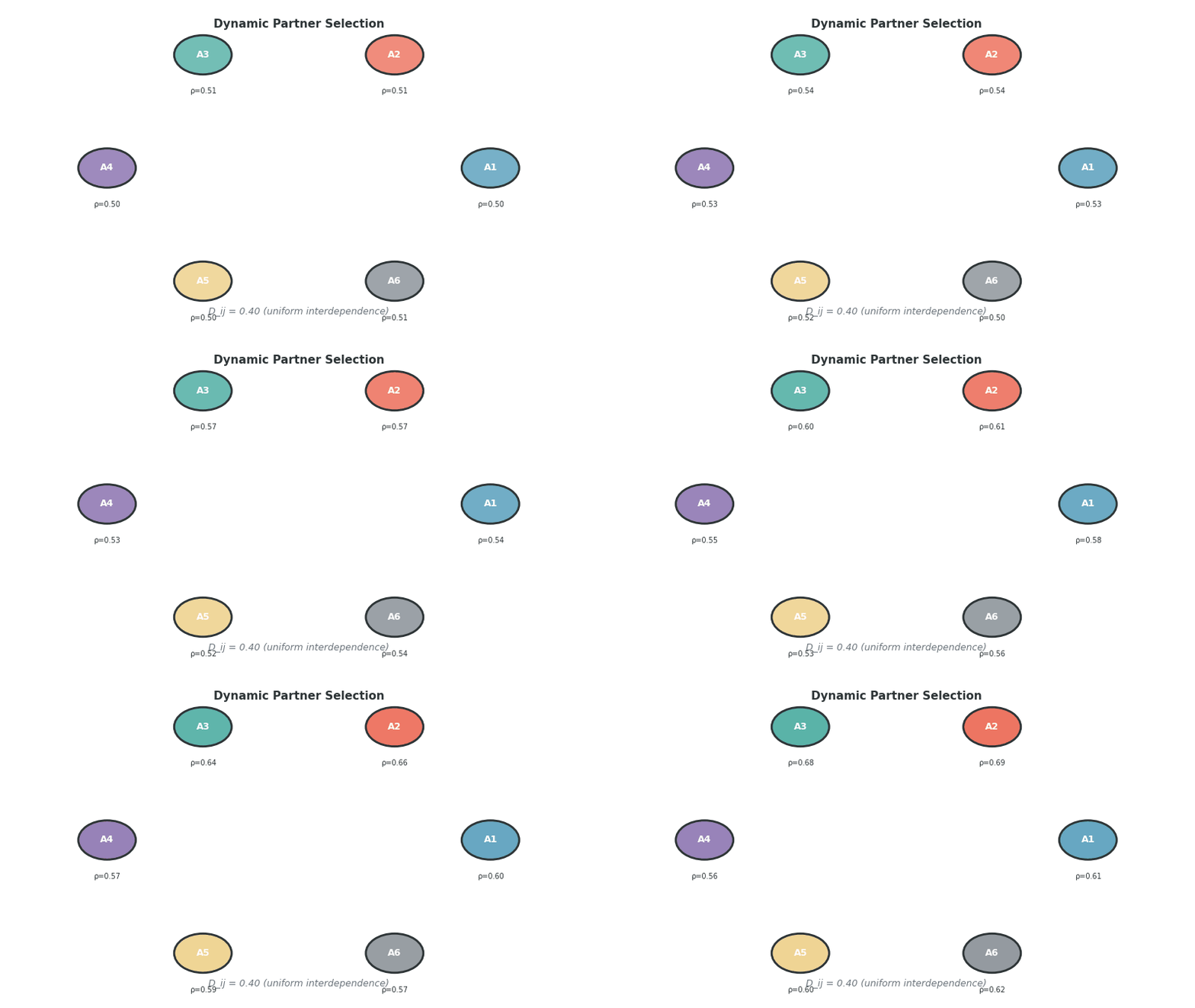 Six-agent marketplace with evolving public reputations. Node size indicates reputation score, edge color shows pairwise trust levels (green=high, red=low). Cooperation builds reputation and attracts quality partners.
MARL Classification
| Property | Value |
|---|---|
| Game Type | Markov Game (N-player, general-sum); Mean-Field Game approximation for large N |
| Cooperation Structure | Mixed-Motive with reputation externalities (cooperation builds public reputation) |
| Observability | Full state + public reputation scores (extended observation) |
| Communication | Implicit (actions + public reputation signals) |
| Agent Symmetry | Symmetric (homogeneous agents with equal endowments and dependencies) |
| Reward Structure | Mixed with uniform interdependence (D_ij = 0.40 for all i≠j) |
| Action Space | Continuous: A_i = [0, 100] for all agents |
| State Dynamics | Deterministic |
| Horizon | Finite, T = 50 steps |
| Canonical Comparison | Reputation games; cf. Resnick & Zeckhauser (2002), rating systems in matching markets |
Formal Specification
This environment is formalized as an N-player symmetric Markov Game with public reputation signals.
Agents
N = {1, …, n} where n = n_agents (default 6), all symmetric:
| Property | Value | Description |
|---|---|---|
| Endowment | 100.0 | Equal for all agents |
| Baseline | 35.0 | 35% cooperation threshold |
| Bargaining α | 1/N | Equal surplus sharing |
State Space
S ⊆ ℝ^d where d = N + 3N² + 1 + N (standard state + reputation vector)
| Component | Dimension | Description |
|---|---|---|
| Actions | N | Previous cooperation levels |
| Trust Matrix | N² | Pairwise trust τ_ij |
| Reputation Damage | N² | Reputation damage R_ij |
| Interdependence | N² | Uniform dependencies D_ij = 0.40 |
| Timestep | 1 | Normalized t/T |
| Public Reputations | N | Global reputation scores ρ_i ∈ [0,1] |
Total dimension: d = N + 3N² + 1 + N = 4N² + 2N + 1
Action Space
For each agent i ∈ {1, …, N}:
A_i = [0, 100] ⊂ ℝ
Uniaxial Treatment: This environment uses the single-dimension action space characteristic of Coopetition-Gym v1.x. Partner competition emerges through reputation-based selection rather than explicit competitive actions.
Interdependence Matrix (Fully Connected)
D_ij = 0.40 for all i ≠ j
D_ii = 0.00
All agents value each other’s outcomes equally, no preferential partnerships.
Reputation Dynamics
Public Reputation Update (exponential moving average):
ρ_i(t+1) = 0.9 · ρ_i(t) + 0.1 · (a_i(t) / e_i)
Properties:
- ρ_i ∈ [0, 1] (normalized cooperation history)
- Persistence parameter α = 0.9 (slow adaptation)
- Publicly observable by all agents
Reward Function
Standard integrated utility with symmetric weights:
r_i = π_i + 0.40 · Σ_{j≠i} π_j
Value function uses $\theta = 18.0$, $\gamma = 0.55$ (moderate complementarity).
Episode Structure
- Horizon: T = 50 steps
- Truncation: t ≥ T
- Termination: None (no early termination)
- Discount: γ = 1.0
Initial State
- τ_ij(0) = 0.50 (neutral trust)
- R_ij(0) = 0.00
- ρ_i(0) = 0.50 (neutral reputation)
Game-Theoretic Background
Reputation-Based Matching
In many real markets:
- Past behavior is publicly observable (ratings, reviews, track records)
- Reputation affects future opportunities
- Agents must balance short-term gains against reputation
The Reputation Investment Problem
Short-term incentive: Free-ride on current reputation by defecting
Long-term incentive: Maintain or build reputation for:
- Access to better partners
- Higher value partnerships
- Competitive advantage
Social Learning Dynamics
Agents learn from observing:
- Their own outcomes with partners
- Public reputation changes
- Market-level cooperation patterns
Environment Specification
Basic Usage
import coopetition_gym
import numpy as np

# Create environment with 6 agents (default)
env = coopetition_gym.make("DynamicPartnerSelection-v0")

# Or customize
env = coopetition_gym.make("DynamicPartnerSelection-v0", n_agents=8)

obs, info = env.reset(seed=42)

# Run episode
for step in range(50):
    # All agents choose cooperation levels
    actions = np.random.uniform(40, 70, size=env.n_agents)
    obs, rewards, terminated, truncated, info = env.step(actions)

print(f"Reputation ranking: {info['reputation_ranking']}")
Parameters
| Parameter | Default | Description |
|---|---|---|
n_agents |
6 | Number of agents in marketplace |
max_steps |
50 | Maximum timesteps per episode |
reputation_weight |
0.5 | How much reputation affects compatibility |
render_mode |
None | Rendering mode |
Agent Configuration
Endowments
All agents have equal endowment:
- Endowment: 100.0 for each agent
Bargaining Shares
Equal bargaining power:
- Alpha: 1.0/N for each agent
Interdependence
Fully connected graph with uniform dependencies:
D[i,j] = 0.40 for all i ≠ j
D[i,i] = 0.00
All agents value each other’s outcomes equally.
Reputation System
Global Reputation Scores
Each agent maintains a public reputation score in [0, 1]:
# Initial reputation
reputations = [0.5] * n_agents  # All start at 0.5

# Update after each step
for i, agent in enumerate(agents): coop_score = actions[i] / endowments[i]  # [0, 1]
    reputations[i] = 0.9 * reputations[i] + 0.1 * coop_score
Reputation Properties
- Persistence: Exponential moving average (α = 0.1)
- Observable: Included in extended observation space
- Bounded: Clamped to [0, 1]
- Episode persistence: Can carry across episodes (optional)
Resetting Reputation
# Reset reputation at episode start
obs, info = env.reset(options={"reset_reputation": True})

# Keep reputation from previous episode
obs, info = env.reset(options={"reset_reputation": False})
Observation Space
Extended Observation
The observation includes standard components plus reputation:
| Component | Shape | Description |
|---|---|---|
| Standard | N + 3N² + 1 | Actions, trust, reputation damage, interdependence, step |
| Reputation | N | Public reputation scores |
Total dimension: Base + N
Reputation Observation
Agents can see all other agents’ reputations:
obs[-n_agents:] # Reputation scores for all agents
Trust Dynamics
Parameters
| Parameter | Symbol | Value | Description |
|---|---|---|---|
| Trust Building Rate | λ⁺ | 0.12 | Moderate building |
| Trust Erosion Rate | λ⁻ | 0.35 | Standard erosion |
| Reputation Damage | $\mu_R$ | 0.60 | Strong reputation effects |
| Reputation Decay | $\delta_R$ | 0.015 | Very slow forgetting |
| Interdependence Amp. | ξ | 0.45 | Moderate amplification |
| Signal Sensitivity | κ | 1.2 | Moderate sensitivity |
| Initial Trust | τ₀ | 0.50 | Neutral start |
Reputation-Trust Interaction
High reputation leads to:
- Faster trust building with new partners
- Higher initial trust in new relationships
- Buffer against trust erosion
Value Function
Parameters
| Parameter | Value | Description |
|---|---|---|
| θ | 18.0 | Moderate logarithmic scale |
| γ | 0.55 | Moderate complementarity |
Metrics and Info
The info dictionary includes:
| Key | Type | Description |
|---|---|---|
step |
int | Current timestep |
public_reputations |
ndarray | All agents’ reputations |
reputation_ranking |
list | Agents sorted by reputation (descending) |
mean_reputation |
float | Market average reputation |
reputation_std |
float | Reputation inequality measure |
mean_cooperation |
float | Average cooperation level |
Strategic Analysis
Reputation Investment Strategies
Build Reputation Early:
- Cooperate heavily in initial steps
- Establish high reputation for later benefits
- Front-load costs for back-loaded returns
Maintain Reputation:
- Cooperate enough to preserve current level
- Balance investment against returns
- Sustainable steady-state strategy
Exploit Reputation:
- Build reputation then defect
- Cash in on established trust
- Risky if market has memory
Partner Selection Logic
Agents implicitly “select” partners through action levels:
- High cooperation → signal desire for partnership
- Low cooperation → signal distrust or exit
- Reputation affects expected partner quality
Equilibrium Dynamics
In equilibrium:
- High-reputation agents match with each other
- Low-reputation agents face adverse selection
- Stratification emerges naturally
Example: Reputation-Based Strategy
import coopetition_gym
import numpy as np

env = coopetition_gym.make("DynamicPartnerSelection-v0", n_agents=6)
obs, info = env.reset(seed=42, options={"reset_reputation": True})

# Track my reputation (agent 0)
my_reputation_history = []

for step in range(50):
    # Strategy: Cooperate proportionally to own reputation
    # High reputation -> maintain it; Low -> build it
    my_rep = info['public_reputations'][0]

    if my_rep < 0.6:
        # Build reputation
        my_action = 80.0  # 80% cooperation
    else:
        # Maintain with moderate cooperation
        my_action = 60.0  # 60% cooperation

    # Other agents: Random strategies
    other_actions = np.random.uniform(30, 70, size=5)

    actions = np.concatenate([[my_action], other_actions])
    obs, rewards, terminated, truncated, info = env.step(actions)

    my_reputation_history.append(info['public_reputations'][0])

print(f"Final reputation: {my_reputation_history[-1]:.3f}")
print(f"My rank: {info['reputation_ranking'].index(0) + 1} of 6")
Research Applications
DynamicPartnerSelection-v0 is suitable for studying:
- Reputation Systems: Design and dynamics
- Social Learning: Learning from public signals
- Market Design: Matching market mechanisms
- Strategic Signaling: Reputation as signal
- Multi-Agent RL: Coordination in large populations
Related Environments
- ReputationMarket-v0: Tiered reputation effects
- PlatformEcosystem-v0: Platform-mediated matching
- TrustDilemma-v0: Dyadic trust building
References
- Resnick, P. & Zeckhauser, R. (2002). Trust Among Strangers in Internet Transactions. Advances in Applied Microeconomics.
- Dellarocas, C. (2003). The Digitization of Word of Mouth. Management Science.
- Pant, V. & Yu, E. (2025). Computational Foundations for Strategic Coopetition: Formalizing Trust and Reputation Dynamics. arXiv:2510.24909