CooperativeNegotiation-v0
Category: Extended Environment
Agents: 2
Difficulty: Advanced
Source: coopetition_gym/envs/extended_envs.py
Overview
CooperativeNegotiation-v0 implements a multi-round negotiation environment with explicit commitment mechanics. Agents submit proposals that, when aligned, form binding agreements. Violating these agreements incurs significant penalties.
This environment tests:
- Communication through actions: Signaling intentions via proposals
- Trust building: Establishing credibility through consistency
- Commitment and enforcement: Understanding contract dynamics
- Breach penalties: Learning consequences of defection
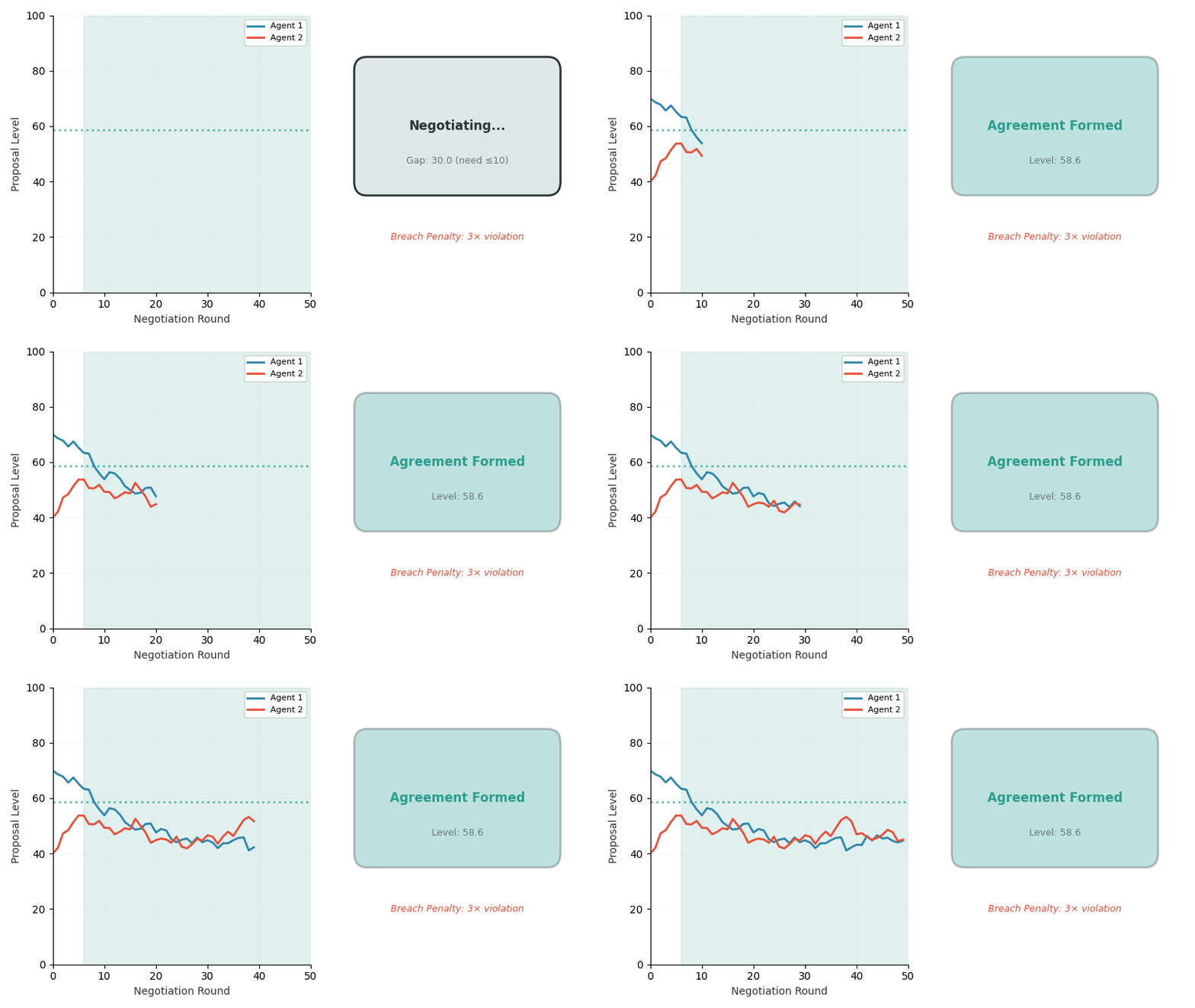 Left: Proposal convergence as agents adjust positions toward agreement. Right: Agreement status timeline showing negotiation (blue), agreement (green), and breach (red) phases with 3× penalty multiplier.
MARL Classification
| Property | Value |
|---|---|
| Game Type | Markov Game with endogenous commitment (contract formation) |
| Cooperation Structure | Mixed-Motive with enforceable agreements |
| Observability | Full (including agreement status and terms) |
| Communication | Implicit proposals (actions encode offers) + explicit agreements |
| Agent Symmetry | Symmetric |
| Reward Structure | Mixed + breach penalties (3× multiplier on violations) |
| Action Space | Continuous: A_i = [0, 100] (proposals/commitments) |
| State Dynamics | Deterministic with discrete agreement transitions |
| Horizon | Finite, T = 100 |
| Canonical Comparison | Contract games with commitment; cf. Crawford & Sobel (1982), Raiffa (1982) negotiation theory |
Formal Specification
This environment is formalized as a 2-player Markov Game with endogenous agreement formation.
Agents
N = {1, 2} (symmetric negotiators)
| Property | Value |
|---|---|
| Endowment | 100.0 |
| Baseline | 35.0 |
| Bargaining α | 0.50 |
State Space
S ⊆ ℝ¹⁸ (extended with agreement info)
| Component | Dimension | Description |
|---|---|---|
| Standard State | 15 | Actions, trust, reputation, interdependence, time |
| Agreement Levels | 2 | Agreed cooperation levels (or -1 if no agreement) |
| Has Agreement | 1 | Boolean flag (0 or 1) |
Action Space
A_i = [0, 100] ⊂ ℝ representing either:
- Pre-agreement: Proposal for cooperation level
- Post-agreement: Actual cooperation level (subject to breach detection)
Uniaxial Treatment: This environment uses the single-dimension action space characteristic of Coopetition-Gym v1.x. Competition emerges through commitment enforcement and breach penalties rather than explicit competitive actions.
Agreement Formation
Agreement condition: Proposals converge within threshold
|a_1 - a_2| ≤ agreement_threshold (default: 10.0)
When agreement forms:
agreed_level = (a_1 + a_2) / 2
Breach Detection
Post-agreement, deviations trigger penalties:
if |a_i - agreed_level_i| > agreement_threshold: breach_penalty = breach_multiplier × |a_i - agreed_level_i|
    r_i = r_i - breach_penalty
where breach_multiplier = 3.0 (default).
Trust Parameters
| Parameter | Symbol | Value | Note |
|---|---|---|---|
| Trust Building | λ⁺ | 0.12 | Faster (agreement builds trust) |
| Trust Erosion | λ⁻ | 0.40 | High (breach penalty) |
| Reputation Damage | $\mu_R$ | 0.65 | Strong (breach = reputation damage) |
| Reputation Decay | $\delta_R$ | 0.02 | Standard |
Reward Function
r_i = π_i + 0.55 · π_j - breach_penalty_i
Breach penalty makes defection costly post-agreement.
Episode Structure
- Horizon: T = 100 steps
- Truncation: t ≥ T
- Termination: mean(τ) < 0.05
- Discount: γ = 1.0
Initial State
- τ_ij(0) = 0.50 (neutral)
- R_ij(0) = 0.00
- has_agreement = False
- agreed_levels = None
Game-Theoretic Background
Negotiation Theory
Real-world negotiations involve:
- Proposal exchange: Parties state positions
- Convergence: Moving toward mutual agreement
- Commitment: Agreeing to specific terms
- Enforcement: Penalties for violation
The Commitment Problem
Without commitment mechanisms:
- Agreements are cheap talk
- Defection is tempting post-agreement
- Trust is hard to establish
With commitment mechanisms:
- Agreements become credible
- Breach penalties align incentives
- Trust can be built through consistency
Environment Specification
Basic Usage
import coopetition_gym
import numpy as np

env = coopetition_gym.make("CooperativeNegotiation-v0")
obs, info = env.reset(seed=42)

for step in range(100):
    # Actions are proposals/commitments
    agent_0_proposal = 55.0  # Propose 55% cooperation
    agent_1_proposal = 52.0  # Propose 52% cooperation

    actions = np.array([agent_0_proposal, agent_1_proposal])
    obs, rewards, terminated, truncated, info = env.step(actions)

    if info['agreement_reached']: print(f"Agreement reached at step {step}!")
        print(f"Agreed levels: {info['current_agreement']}")
Parameters
| Parameter | Default | Description |
|---|---|---|
max_steps |
100 | Maximum timesteps |
agreement_threshold |
10.0 | Max proposal difference for agreement |
breach_penalty_multiplier |
3.0 | Penalty for violating agreement |
negotiation_rounds |
5 | Rounds before commitment (unused in current) |
render_mode |
None | Rendering mode |
Agreement Mechanics
Reaching Agreement
An agreement is reached when proposals are close:
proposal_diff = abs(action_0 - action_1)
if proposal_diff <= agreement_threshold: agreement_reached = True
    agreed_level = (action_0 + action_1) / 2  # Average
Agreement State
Once an agreement is reached:
- Agreed levels are recorded
- Subsequent actions are compared to agreement
- Deviations trigger breach penalties
Breach Detection
if has_agreement: for agent in [0, 1]: deviation = abs(action[agent] - agreement[agent])
        if deviation > agreement_threshold: breach_occurred = True
            penalty = breach_penalty_multiplier * deviation
            rewards[agent] -= penalty
Observation Space
Extended Observation
| Component | Shape | Description |
|---|---|---|
| Standard | 15 | Actions, trust, rep, interdep, step |
| Agreement Levels | 2 | Agreed cooperation levels (or -1) |
| Has Agreement | 1 | Boolean flag |
Total dimension: 18
Agreement Information in Observation
# Check agreement status from observation
has_agreement = obs[-1] > 0.5  # Last element is flag
if has_agreement: agreed_levels = obs[-3:-1]  # Second-to-last elements
Reward Structure
Base Rewards
Standard integrated utility (see TrustDilemma-v0).
Breach Penalty
When an agent deviates from agreement:
penalty = breach_penalty_multiplier × |action - agreed_level|
reward = base_reward - penalty
With multiplier = 3.0:
- Deviation of 10 units → penalty of 30
- Deviation of 20 units → penalty of 60
This makes breach very costly.
Trust Dynamics
Parameters
| Parameter | Symbol | Value | Description |
|---|---|---|---|
| Trust Building Rate | λ⁺ | 0.12 | Moderate building |
| Trust Erosion Rate | λ⁻ | 0.40 | High erosion (breach penalty) |
| Reputation Damage | $\mu_R$ | 0.65 | Strong reputation effects |
| Reputation Decay | $\delta_R$ | 0.02 | Standard decay |
| Interdependence Amp. | ξ | 0.55 | Moderate amplification |
| Signal Sensitivity | κ | 1.2 | Enhanced sensitivity |
| Initial Trust | τ₀ | 0.50 | Neutral start |
Breach Impact on Trust
Breaching an agreement:
- Triggers trust erosion (high λ⁻)
- Adds reputation damage (high $\mu_R$)
- Affects future interactions
Metrics and Info
The info dictionary includes:
| Key | Type | Description |
|---|---|---|
step |
int | Current timestep |
agreement_reached |
bool | Whether agreement exists |
current_agreement |
tuple | Agreed levels (or None) |
breach_occurred |
bool | Whether breach this step |
total_agreements |
int | Cumulative agreements |
total_breaches |
int | Cumulative breaches |
proposal_convergence |
float | 1 - (diff / 100) |
Strategic Analysis
Negotiation Strategies
Gradual Convergence:
- Start with moderate proposals
- Adjust based on partner’s response
- Converge to mutually acceptable level
Aggressive Opening:
- Start with favorable proposal
- See if partner concedes
- Risk: may delay agreement
Matching Strategy:
- Mirror partner’s proposal
- Signal willingness to agree
- Quick convergence but may not optimize
Post-Agreement Strategies
Honor Commitment:
- Match agreed level exactly
- Build trust for future negotiations
- Avoid all penalties
Minor Deviation:
- Small deviation under threshold
- No penalty but trust impact
- Short-term gain possible
Major Breach:
- Large deviation exceeding threshold
- Severe penalty
- Trust collapses
Example: Negotiation Protocol
import coopetition_gym
import numpy as np

env = coopetition_gym.make("CooperativeNegotiation-v0")
obs, info = env.reset(seed=42)

# Negotiation state
my_proposal = 60.0
partner_last = 50.0

for step in range(100):
    # Simple convergence: move toward partner
    if not info.get('agreement_reached', False):
        # Negotiation phase: move toward partner
        my_proposal = 0.7 * my_proposal + 0.3 * partner_last
    else:
        # Agreement phase: honor commitment
        my_proposal = info['current_agreement'][0]

    # Partner uses similar logic (simulated)
    partner_proposal = 0.6 * partner_last + 0.4 * my_proposal

    actions = np.array([my_proposal, partner_proposal])
    obs, rewards, terminated, truncated, info = env.step(actions)

    partner_last = obs[1]  # Partner's last action

    if step == 20: print(f"Step 20: Agreement={info['agreement_reached']}, "
              f"Proposals=({my_proposal:.1f}, {partner_proposal:.1f})")

print(f"\nFinal: {info['total_agreements']} agreements, "
      f"{info['total_breaches']} breaches")
Research Applications
CooperativeNegotiation-v0 is suitable for studying:
- Contract Theory: Commitment and enforcement
- Negotiation: Multi-round bargaining dynamics
- Communication: Signaling through actions
- Institutional Design: Agreement mechanisms
- MARL with Commitments: Learning with binding agreements
Related Environments
- TrustDilemma-v0: Without explicit contracts
- PartnerHoldUp-v0: Power-asymmetric negotiation
- ReputationMarket-v0: Market-level agreements
References
- Crawford, V.P. & Sobel, J. (1982). Strategic Information Transmission. Econometrica.
- Raiffa, H. (1982). The Art and Science of Negotiation. Harvard University Press.
- Pant, V. & Yu, E. (2025). Computational Foundations for Strategic Coopetition: Formalizing Trust and Reputation Dynamics. arXiv:2510.24909